Guest Post from Pete Bates, The Pete Bates Project
I wasn’t swinging because I was physically threatened. I was swinging because I was intellectually threatened.
That’s something it took me a very long time to understand about myself. When I was a young man, I didn’t know how to argue without becoming aggressive. I didn’t know how to properly articulate what I was thinking, explain what I was feeling, or defend a position when somebody challenged me.
I could feel something strongly without having the language to explain why. And when somebody could articulate themselves better than I could, I often experienced that as humiliation. I wasn’t necessarily frightened of the person standing in front of me. I was frightened of being exposed.
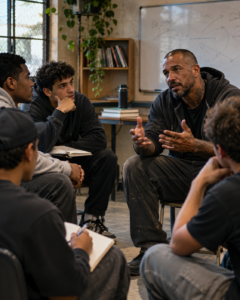 Exposed as somebody who couldn’t find the words. Somebody who couldn’t construct an argument. Somebody who couldn’t explain himself without becoming frustrated, defensive or angry. And instead of recognising that limitation, I’d turn the situation into something I understood.
A physical confrontation. I couldn’t win the argument with my words, so I’d try to end it with my fists.
For a long time, I confused that with strength. It wasn’t strength. It was a failure in the way I had learnt to respond to being challenged. And I want to make something absolutely clear. That doesn’t excuse a single act of violence.
Every time I chose to use my fists, I was responsible for that decision. The person on the receiving end wasn’t responsible for my inability to communicate, my frustration or my pride. Those were mine to manage.
But if we’re serious about understanding harmful behaviour, we have to be prepared to examine the thinking that comes before it, because for me, there was something happening long before the first punch was thrown. There was the belief that disagreement meant disrespect. That being corrected meant being humiliated. That another person having a stronger argument somehow made me weaker.
And that if I couldn’t establish myself intellectually, I could establish myself physically. I hadn’t learnt how to tolerate being wrong without feeling diminished as a man. Then something happened in prison that began to change the way I understood myself and other people.
An officer handed me an encyclopaedia. It might sound like such a small thing. But for somebody who had struggled with reading and who had spent so much of his life responding to the world through anger, aggression and poor decisions, it opened a door I hadn’t known how to walk through. I began educating myself.
Eventually, I found Dale Carnegie’s How to Win Friends and Influence People. That book had a profound influence on how I began thinking about communication, disagreement and human relationships. I started to understand that having a conversation wasn’t about defeating the other person. That listening didn’t mean surrendering. That acknowledging somebody else’s point didn’t mean abandoning my own. That being challenged wasn’t automatically an attack. And that I could disagree with someone without needing to dominate them.
But perhaps the most important change was internal. As my ability to read, think, reason and articulate myself developed, I began to feel less threatened by somebody else’s intelligence. I no longer needed every disagreement to become a contest over who was stronger.
I could slow down. Listen. Think. Find the words.
I could recognise that another person’s argument might contain something worth considering, even when I didn’t agree with them. And sometimes, I could simply accept that I was wrong. Education didn’t just give me more information. It gave me another way to respond to the world. It helped me organise thoughts that previously came out as frustration. It gave me language for things I had felt but couldn’t explain. It gave me the ability to question beliefs I’d carried for years without ever properly examining them.
And it helped me understand something I wish I’d understood much earlier: You don’t lose your dignity because somebody disagrees with you.
I think about this often when I see young men who are constantly arguing, pushing back, challenging authority, fighting and reacting to everything as though it’s a personal attack.
I’m not suggesting they’re all like I was. They’re not. Some aggression is deliberate. Some violence is calculated and controlling. Some people understand perfectly well what they’re doing. Poor communication must never become a blanket explanation or excuse for abuse.
But I do wonder how many young people are growing up with enormous feelings and very little ability to put those feelings into words. How many have learnt to defend themselves physically before they’ve learnt to defend an idea?
How many can recognise anger but cannot explain the embarrassment, insecurity, shame or fear sitting underneath it? How many interpret correction as humiliation because nobody has taught them that being wrong is part of learning? And how many have been told repeatedly to control their anger without ever being given the practical skills to communicate what is happening inside them?
We tell young men to make better decisions. We tell them to stop fighting. We tell them violence isn’t the answer. And those messages matter. But we also need to teach the capabilities that make different responses possible.
Teach them to read. Teach them to question what they believe. Teach them to organise their thoughts. Teach them how to construct an argument without attacking a person. Teach them to recognise when their pride is being challenged rather than their safety. Teach them that listening is not weakness. That changing your mind is not humiliation. That walking away from an argument doesn’t mean you’ve lost. And that being able to explain yourself is far more useful than being able to intimidate somebody.
None of this removes accountability. A young man who uses violence must still be held responsible for the harm he causes. And the people he hurts must never be made responsible for educating him out of it.
Education is not a guaranteed prevention strategy. It doesn’t automatically change someone’s values, eliminate aggression or stop coercive behaviour. But it can give a person capacities they didn’t previously possess. And that matters.
Because I know what it was like to stand in front of somebody with an argument I couldn’t answer, and to feel that familiar anger rising because I had nowhere else to go with it. I also know what it was like, years later, to discover that I could use my words. That I could make myself understood. That I could disagree without violence. That I could marshal my thoughts and explain what I actually believed.
I can’t undo the harm I caused before I learnt those lessons. I can’t get those years back. But I can explain why education became one of the most important turning points of my life. It wasn’t simply about becoming a better reader. It was about becoming a man who no longer needed to turn an intellectual challenge into a physical confrontation.
And that’s why I believe education, language, reasoning and communication deserve a much more serious place in how we work with young people. Not just the young people who are already doing well. Especially the ones who resist. The ones who struggle. The ones who fight everything. The ones who have been written off as difficult.
Because sometimes, underneath all that resistance, is a young person who has never been given the tools to make themselves understood. And while those tools will never remove their responsibility for what they choose to do, they might give them another choice before they cause harm.
I spent years using my fists because I couldn’t find the words.
I wish somebody had taught me the power of those words before I learnt the consequences of living without them.
Pete Bates, The Pete Bates Project, Petebatesproject.com