Definition of Hyperbaric Oxygen Therapy (HBOT)
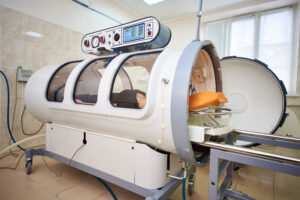
Hyperbaric oxygen therapy (HBOT) involves breathing highly concentrated oxygen in a chamber pressurized at a far higher level than normal atmospheric pressure, to force more oxygen into the bloodstream and lungs, so it can be delivered to cells and damaged tissues. In medicine it’s been used for decades to treat conditions such as severe burns, non-healing wounds and radiation injury. In wellness and longevity programs, it’s increasingly used as a preventive or performance-support therapy aimed at enhancing recovery, energy metabolism and cognitive function, rather than treating serious medical conditions.
The strongest evidence for HBOT comes from medical studies carried out under strict conditions, including receiving 100% oxygen in special hard shell or steel chambers, over an extended period of time (for example, 5 days a week for months.) Spas and wellness centers instead often use soft-shell chambers (which can pose a risk of fire or suffocation) and with often sporadic treatment, so the evidence that exists for medical-grade equipment and strict protocols that are overseen by a doctor simply cannot be applied to most commercial HBOT. See the New York Times article on this critical distinction and how oxygen, pressure, equipment, and duration protocols can be so different.
Explore hyperbaric oxygen therapy research in the following medical databases: PubMed Trip Cochrane*
*The Cochrane database requires users to enter the search term manually. Please enter ‘hyperbaric oxygen therapy’.
AI Search: Access Semantic Scholar’s results on hyperbaric oxygen therapy. Semantic Scholar
Learn more about our 3 research databases and AI search platform HERE.
Research Spotlight
The databases often return hundreds of medical studies for a single wellness approach. This section provides a sampling of studies – providing just a taste of the available research.
-
- Hyperbaric oxygen therapy showed significant symptom relief for complex regional pain syndrome A 2025 metareview from global medical researchers (Harvard Medical School, University of Padua, etc.) analyzed 13 studies on hyperbaric oxygen therapy’s efficacy in treating the challenging condition of complex regional pain syndrome (CRPS), focusing on both sympathetically maintained pain (SMP) and sympathetically independent pain (SIP). HBOT treatment ranged from 3 to 63 sessions, typically using 2.4 atmospheres absolute for 90 minutes. The results indicated significant symptom relief and functional improvement across both SMP and SIP pain subtypes. HBOT’s anti-inflammatory and neuroplasticity promoting properties make it a valuable noninvasive option for CRPS patients. Further research is necessary to optimize treatment protocols. Access this study on hyperbaric oxygen therapy.
- Ten sessions of hyperbaric oxygen therapy didn’t show more benefits than placebo for Long Covid patients A 2025 randomized, placebo-controlled, double-blind clinical trial from Karolinska University Hospital, Stockholm, on 80 participants with Long Covid, tested whether HBOT could help people with symptoms, such as fatigue, cognitive difficulties (“brain fog”), and reduced physical capacity. Their protocol: 10 sessions of HBOT (involving 100% oxygen, 2.4 bar, for 90 minutes) vs. placebo treatments over six weeks. Their finding: while both groups improved, the 10 HBOT sessions did not show more short-term benefits than placebo in symptoms for Long Covid patients. Access this study on hyperbaric oxygen therapy.
- Hyperbaric oxygen therapy improved VO2 max, oxygen consumption, and cardiac blood flow in older adults A 2024 randomized controlled trial (63 adults over 64 years old) at Shamir Medical Center, Israel, found that HBOT has the potential to improve physical performance in aging adults. A three-month long protocol saw significant improvements in key factors including VO2 Max (maximal oxygen consumption) and VO2VT1. An important mechanism contributing to these improvements is the heightened cardiac perfusion induced by HBOT. The protocol was administered in a medical grade multiplace Starmed-2700 chamber and involved 60 daily sessions over a three-month period––where participants breathed 100% oxygen by mask for 90 minutes. Access this study on hyperbaric oxygen therapy.
- Hyperbaric oxygen therapy: future prospects in regenerative therapy and anti-aging This 2024 metareview from researchers at Datta Meghe Institute of Medical Sciences, India, examined how HBOT might be used in regenerative medicine and anti-aging therapies. The authors explain that intermittent exposure to high oxygen levels can stimulate biological responses such as improved blood vessel growth, stem cell activation, reduced inflammation, and enhanced tissue repair. These mechanisms may help support recovery from injuries and potentially slow some aging-related processes. However, this review of studies emphasizes that while early results are promising, more rigorous clinical trials are needed before HBOT can be widely adopted as an effective anti-aging treatment. Access this study on hyperbaric oxygen therapy.
- Hyperbaric oxygen therapy for Alzheimer’s disease? Some evidence, but more high-quality studies needed before any conclusions could be drawn A 2024 Shanghai University of Traditional Chinese Medicine metareview analyzed results from several randomized controlled trials to evaluate whether HBOT could help people with Alzheimer’s disease. The researchers found evidence suggesting HBOT may improve cognitive function, daily living abilities, and neurological symptoms in some patients compared with standard care. The therapy is thought to help by improving oxygen delivery to the brain, reducing inflammation, and supporting neuronal repair. However, the review highlights limitations in the available studies, including small sample sizes and variations in treatment protocols. More high-quality trials with consistent protocols are needed before conclusions can be drawn. Access this study on hyperbaric oxygen therapy.
- Hyperbaric oxygen therapy increased telomere length and decreased immunosenescence in isolated blood cells A small (35 participants) 2020 clinical trial at Shamir Medical Center, Israel, found that HBOT improved two key hallmarks of aging in immune cells: increasing telomere length and decreasing damaging “zombie cells.” The therapy was administered in a medical grade Multiplace Starmed-2700 chamber and involved 60 daily sessions (over 3 months) where participants breathed 100% oxygen by mask for 90 minutes. Participants’ telomeres (the protective caps at the ends of chromosomes that shorten as we age) increased in length, while the number of senescent immune cells (aging cells that no longer function properly) decreased. These results suggest that HBOT may influence processes related to cellular aging and immune system decline, though the study was relatively small and did not include a control group, so further research is needed. Access this study on hyperbaric oxygen therapy.
- Hyberbaric oxygen therapy improved cognitive function in healthy older adults A 2020 randomized controlled trial (63 healthy adults over age 64) at Shamir Medical Center, Israel, found that HBOT induced cognitive enhancements via mechanisms involving regional changes in cerebral blood flow. The main improvements included attention, information processing speed and executive functions, which normally decline with aging. The protocol was administered in a medical grade multiplace Starmed-2700 chamber and comprised 60 daily sessions, 5 sessions per week, over a three-month period––where participants breathed 100% oxygen by mask for 90 minutes. The control arm received no active intervention. Access this study on hyperbaric oxygen therapy.
- Hyperbaric oxygen therapy for healthy aging: From mechanisms to therapeutics This 2022 scientific review from Shanghai Jiao Tong University School of Medicine looked at the evidence for how HBOT may affect biological mechanisms associated with aging. The authors describe how controlled exposure to high oxygen levels can trigger adaptive responses in the body, often called the “hyperoxic-hypoxic paradox,” which may stimulate cellular repair processes, increase stem cell activity, reduce inflammation, and improve blood flow. The available evidence suggests that HBOT may help address age-related conditions such as cognitive decline, reduced physical performance, and tissue degeneration. However, the authors stress that while early research is encouraging, more large-scale human trials are necessary to establish clear clinical guidelines. Access this study on hyperbaric oxygen therapy.
- Hyperbaric oxygen therapy significantly improved pathophysiology of skin aging and collagen density A 70 participant, 2021 study at Shamir Medical Center, Israel, was the first to find that HBOT can significantly modulate the pathophysiology of the skin aging in a healthy population. HBOT led to significant improvements in collagen density, skin elasticity, and blood vessel formation. It was the first human study that demonstrated that a therapeutic intervention could reduce the number of senescent cells at the tissue level. The protocol was administered in a medical grade multiplace Starmed-2700 chamber and comprised 60 daily sessions, 5 sessions per week, over a three-month period––where participants breathed 100% oxygen for 90 minutes. The study’s limitations: a relatively small sample size and no placebo intervention. Access this study on hyperbaric oxygen therapy.
Studies-in-Progress/Clinical Trials Underway
A clinical trial is any research study that assigns people to health-related interventions to evaluate the outcomes. “Interventions” include drugs, surgical procedures, devices, behavioral treatments, preventive care, etc.
- ClinicalTrials.gov: search ‘Hyperbaric oxygen therapy’ in box that says “intervention/treatment”.
- World Health Organization: explore trials happening across the globe. When you reach WHO’s search page, please type in ‘hyperbaric oxygen therapy’.
Access all studies currently available for biophilic design in these databases:
PubMed Trip Cochrane* Semantic Scholar
*The Cochrane database requires users to enter the search term manually. Please enter ‘hyperbaric oxygen therapy’.