I recently spent three days in Rochester, Minnesota, at Mayo Clinic, finally making good on my promise to Dr. Brent Bauer, who has for many years invited me to visit. I also took his good advice not to plan the trip during winter (not a fan of below-zero weather) and am happy to report I had two beautiful days with sunshine and perfect temperatures.
UK’s Nat’l Health Service Takes Major Action on Worker Health
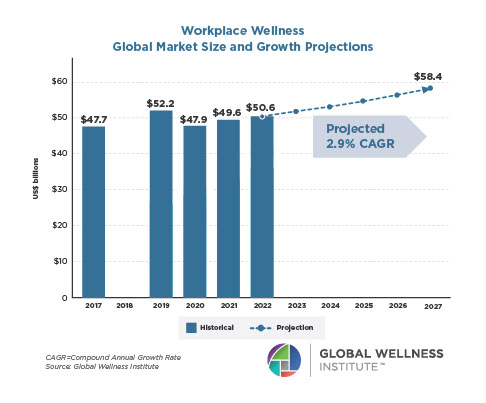
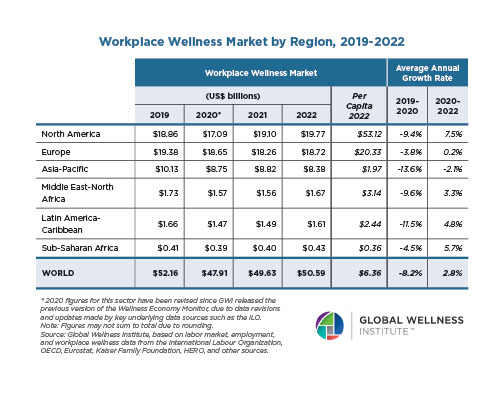
Thierry Malleret argues that persistent global economic weakness is the “new normal,” straining the financial outlook of countries around the world. The upshot: this will make more “well” populations an increasing imperative for governments and businesses everywhere.
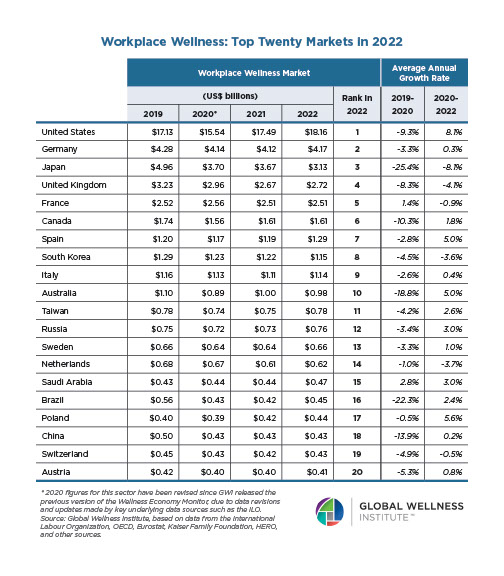
A great new example of action being taken: The UK’s National Health Service, the fifth-biggest employer in the world (and with one of England’s most unhealthy employee populations), has decided that a “healthy workplace” is no longer a “nice to have, but a must-do.” So it’s investing millions in things like healthy food, yoga and Zumba classes for staff.
Read more about how Malleret predicts that two macro forces—ongoing global economic weakness and an aging population—will increasingly make workplace wellness a strategic imperative.
Global Workplace Wellness Needs to “Get Local”
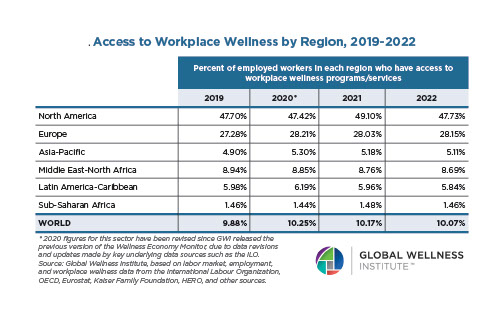
When the experts gathered at the Global Wellness Institute’s (GWI) recent “Redefining Workplace Wellness” roundtable, a key discussion point was how global/multinational workplace wellness initiatives need to toss the cookie-cutter (and U.S.-centric) programs—because if you want to successfully deliver wellness to employees around the world, you need to embrace the local realities and culture. The roundtable shared many specifics: from how Chinese, Indian and Middle Eastern populations have a genetic profile that hits them much harder with obesity and diabetes complications; to how, in Russia, a successful smoking cessation program needs to involve grandma; to how, in countries in Southeast Asia, excluding Ayurveda means excluding the vast majority of the worker population.
Must-Reads from the Wellness World (Week of September 16, 2015)
“The Research Is Clear: Long Hours Backfire for People and for Companies” – Harvard Business Review, August 19, 2015
The bottom line: The “overwork story” is one of diminishing returns—keep overworking, and you’ll progressively work less well on tasks that are increasingly meaningless. There’s a large body of research suggesting that regardless of our reasons for working long hours, overwork does not help us. Not only does it not seem to result in more output, but considerable evidence shows that overwork harms both employees and the companies they work for.
Insight: Workplace Wellness Should Embrace New Tech Solutions, from Telemedicine to Online Coaching
At the Global Wellness Institute’s (GWI) recent “Redefining Workplace Wellness” roundtable, the experts discussed how technology is the ultimate double-edged sword when it comes to workplace wellness: Technology is “killing” employees with 24/7 connections—but is also delivering incredible, new tools that can radically help with their physical and mental health. Businesses will increasingly embrace telemedicine and online coaching—even sensors in chairs that nudge workers to get up and stretch. And the future is going to look, well, futuristic: Move over clunky wearable devices because invisible, ingestible nanotechnology will soon effortlessly capture worker’s biometric data 24/7.
Yes, Iran Has Big Potential in Wellness Tourism
The recent P5+1 agreement with Iran (P5+1 refers to the six world powers—China, France, Russia, the UK, the U.S. and Germany—that have been working together diplomatically regarding Iran’s nuclear program) has the potential to alter the global geo-economic landscape in the Middle East and beyond. But Thierry Malleret argues it has other implications, namely helping open up a wellness tourism market with serious potential. Iran has an extraordinarily rich, ancient history and culture and large tourism companies are already figuring out how to invest.