Exploring the Many Dimensions of Workplace Wellbeing: The 2026 Recommended Reading List
Authors: Talya Landau and Jessica Grossmeier, PhD, MPH
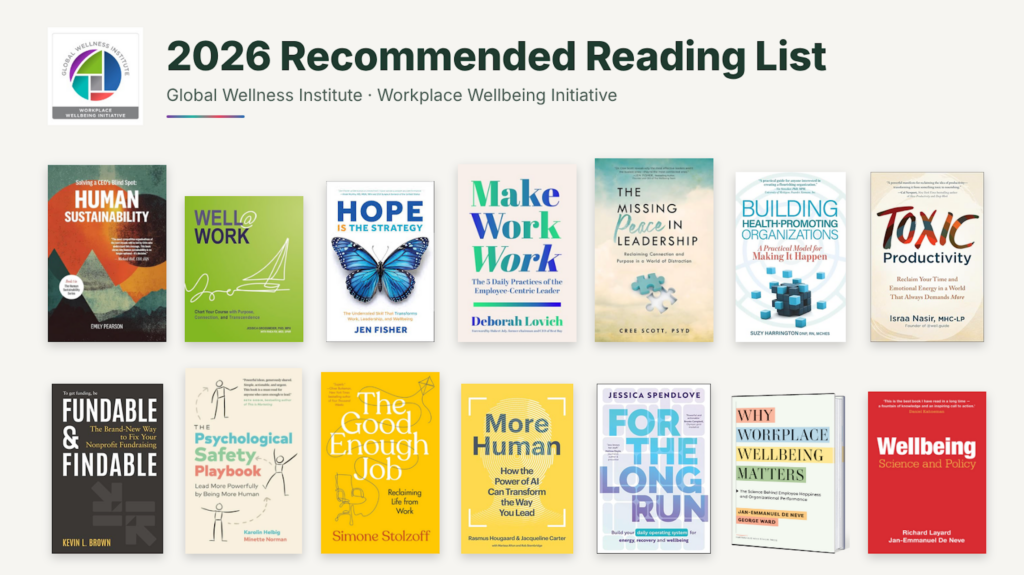
Workplace wellbeing has come a long way from wellness perks and health risk reduction. Today the conversation is about whether work itself is sustainable for the people doing it, and what leaders, teams, and organizations can do to make it so. To support that work, the Workplace Wellbeing Initiative (WWI) of the Global Wellness Institute has updated its Recommended Reading List for 2026, bringing together 14 titles that blend research, practical tools, and lived experience from across the global wellbeing community.
This year’s list reflects where the field is heading. Several new titles strengthen the business case for wellbeing with fresh evidence, while others look at leadership through the lens of hope, connection, psychological safety, and even artificial intelligence. Familiar themes are here too, including burnout, boundaries, and the everyday habits that help people stay well over time.
These recommendations were gathered through collaboration and ongoing dialogue within the global workforce wellbeing community, including authors and Workplace Wellbeing Initiative members. Together, these thinkers represent a broad spectrum of expertise and lived experience, uniting science, strategy, and storytelling to inspire meaningful change at work.
The books featured in this year’s collection offer something for everyone along the wellbeing journey.
For leaders building healthier cultures and systems
- Solving a CEO’s Blind Spot: Human Sustainability newly released by Workplace Wellbeing Initiative member Emily Pearson reframes performance around human sustainability, showing how people and businesses can thrive together.
- Building Health-Promoting Organizations by Suzy Harrington offers a practical model for embedding wellbeing into organizational systems.
- Make Work Work by Deborah Lovich, coming in November 2026, introduces five simple leadership habits that reduce burnout and strengthen engagement.
- Well at Work by Workplace Wellbeing Initiative chair, Jessica Grossmeier and Rhea Fix serves as an interactive guide to feeling more connected, aligned, and fulfilled in any kind of work, whether paid, caregiving, or volunteer.
For those making the case with evidence
- Why Workplace Wellbeing Matters by Jan-Emmanuel De Neve and George Ward connects employee wellbeing to productivity, retention, and business success.
- Wellbeing: Science and Policy by Richard Layard and Jan-Emmanuel De Neve explains what shapes wellbeing, how to measure it, and how evidence can lead to better decisions.
For more human leadership
- Hope Is the Strategy by Workplace Wellbeing Initiative member Jen Fisher treats hope as a skill leaders can build to strengthen resilience and inspire their teams.
- The Missing Peace in Leadership by Cree Scott shows how connection, clarity, and purpose make for more resilient and more human leaders.
- More Human: How the Power of AI Can Transform the Way You Lead by Rasmus Hougaard and Jacqueline Carter explores how AI can support, rather than replace, the human qualities of good leadership.
For teams seeking trust and belonging
- The Psychological Safety Playbook by Karolin Helbig and Minette Norman offers concrete behaviors and tools for building trust, inclusion, and openness within teams.
For tackling burnout and setting boundaries
- Toxic Productivity by Israa Nasir looks at the constant pressure to achieve and offers ways to reclaim time, energy, and personal wellbeing.
- The Good Enough Job by Simone Stolzoff, another returning favorite, encourages healthier boundaries between work, identity, purpose, and the rest of life.
For sustaining energy over the long run
- For the Long Run by Jessica Spendlove helps readers build lasting habits around energy, recovery, sleep, movement, nutrition, and stress management.
For mission-driven organizations
- Fundable & Findable by Kevin L. Brown helps nonprofits and purpose-led organizations strengthen their strategy, storytelling, and visibility so their work can be sustained over time.
What makes this collection special is not just the content of the books, but the community behind them. Each recommendation reflects the collective curiosity, compassion, and commitment of those who believe wellbeing at work is both possible and powerful.
Readers are invited to explore the list, learn from these featured thinkers, and discover new ways to advance wellbeing in their own sphere of influence. This is a living resource, one that will keep growing as understanding of workplace wellbeing deepens. Recommendations for future editions are always welcome!
Explore the full GWI Workplace Wellbeing 2026 Recommended Reading List here
Disclaimer
The blog submissions featured on this site represent the research and opinions of the individual authors. The Global Wellness Institute and the Workplace Wellbeing Initiative are not responsible for the content provided. The views expressed are solely those of the authors and do not necessarily reflect the official policy or position of the Global Wellness Institute or the Workplace Wellbeing Initiative. Readers are encouraged to consult with a qualified healthcare professional for specific health concerns.