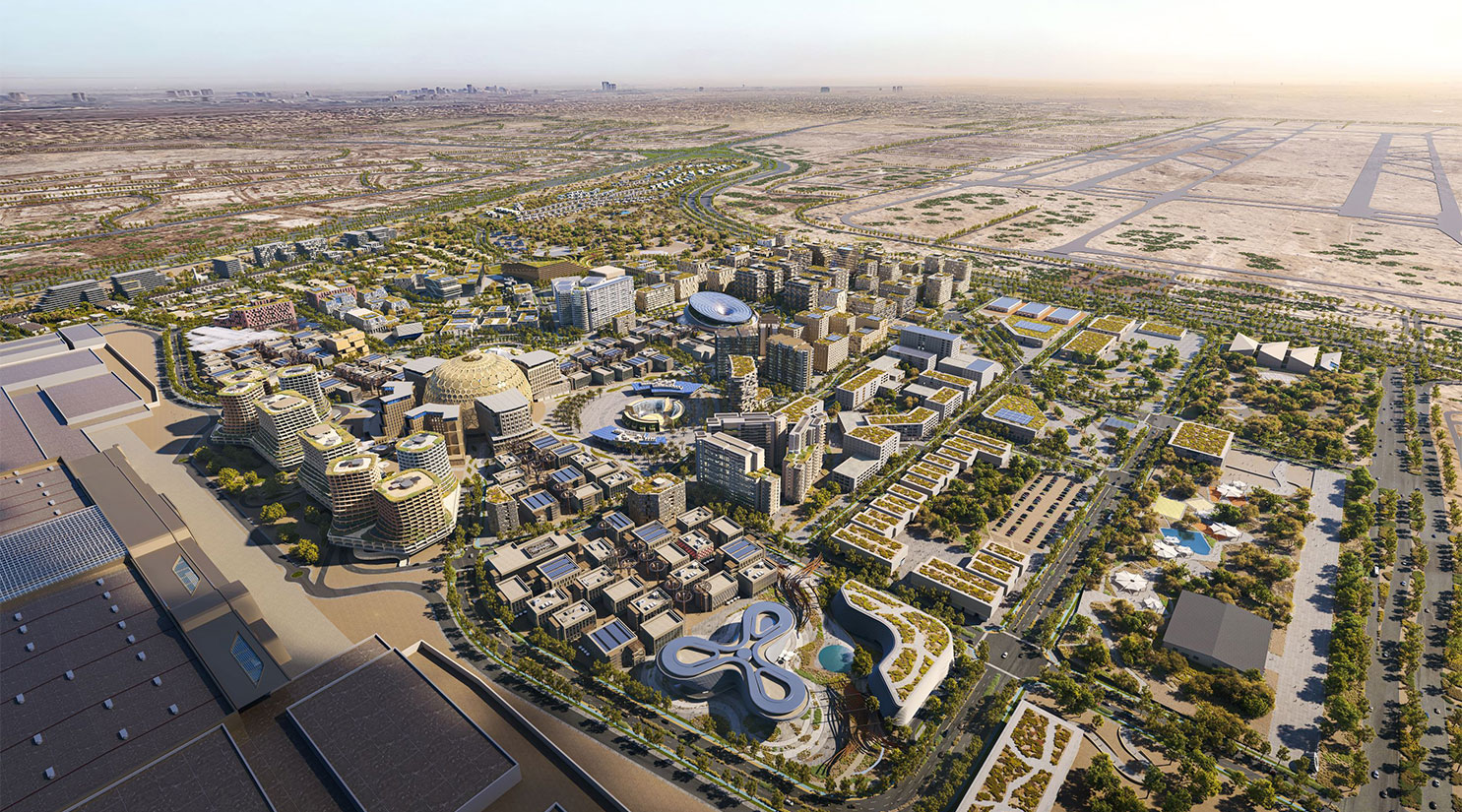
Expo City Dubai
Dubai South, Dubai, United Arab Emirates
Located about 23mi/37km south of downtown Dubai, Expo City Dubai is a master-planned, mixed-use community aiming to become a model of a future-looking, innovation-driven, and people-centric city. Borne out of the legacy site of Expo 2020, it is the first ever World Expo site to be extensively repurposed into a permanent community, with over 80% of the Expo 2020-built infrastructure being preserved or adapted for long-term use. Designed as a 15-minute city, Expo City features multiple residential districts; offices; and educational, healthcare, cultural, and entertainment offerings—including retail, food & beverage, hospitality, conference & event venues, education-driven attractions, a hospital, and a school. It will eventually host 35,000 residents and 40,000 professionals when all development phases are completed.
Expo City Dubai residents will enjoy a walkable, pedestrian-friendly city with extensive recreational and wellness offerings dispersed throughout (walking paths, jogging and cycling tracks, sports fields, fitness and gyms, swimming pools, play areas, etc.). The city’s master plan is split across several districts, encompassing high-density commercial/mixed-use areas and lower-density residential areas. The districts are laid out in a pedestrian-centric grid system to ensure circulation and accessibility; all districts are connected by a network of green and blue spaces, while the pedestrian-first Expo High Street (with retail, restaurants, etc.) connects three of the central districts. The districts include:
- Expo Downtown: A bustling, high-density central district with a pedestrian-centric main street offering retail, dining, and cultural attractions, and directly connected to the metro station. Residential offerings include three high-rise/mid-rise apartment buildings (initial handover scheduled in mid-2026), alongside office and hospitality offerings.
- Expo Fields: A mixed-use, mid-density, wellness-focused district with extensive recreational facilities, a school, retail, food & beverage outlets, and an arena for concerts and festivals. Residential offerings include mid-rise apartments and duplex lofts (handover scheduled in late-2026).
- Expo Valley: Low-density villas, townhouses, and apartments dispersed along a natural green spine, with an undulating landscape overlooking a nature reserve, lake, and wadi, and with extensive wellness amenities. Residences are nearly complete, with handover scheduled in late-2026.
- Expo Business: A campus-like environment for businesses, with extensive indoor and outdoor collaborative and social spaces, flexible and permanent office buildings, a conference center, a theater, a farmers’ market, food & beverage options, and more.
Expo City is the first project in the Middle East region to achieve WELL Community pre-certification and is targeting WELL Gold for its anticipated certification. It has also achieved LEED Cities & Communities Platinum pre-certification and BREEAM Infrastructure V6 Strategy “Excellent” Rating. LEED Gold will continue to be a minimum requirement for all buildings in Expo City Dubai, which is also home to four LEED Platinum buildings and 23 WELL Health-Safety-rated clusters of commercial buildings. Situated between the Dubai Exhibition Center, Jebel Ali Port, and Al Maktoum International Airport (which will become the world’s largest airport after a $35 billion expansion), Expo City Dubai is one of five major hubs in the Dubai 2040 Urban Master Plan.1 Expo City Dubai sees its role as a pilot site for testing and adapting best practices that will deliver maximum social, environmental, and economic impacts, while helping to drive Dubai’s Economic Agenda D33 (which aims to double the size of Dubai’s economy over the next decade).
Distinctive Approaches to Wellness
Leaning into heritage and culture to design a destination community.
Expo City Dubai is leveraging the infrastructure of the World Expo mega-event to build a new permanent destination and community. The legacy of Expo 2020 left many attractive, landmark assets that already make the site a destination for recreation, leisure, and education, and the structures themselves are a showcase for innovative and sustainable design rooted in the local culture and nature. For example:
- Al Wasl Plaza—a community hub and the symbolic heart of Expo 2020 Dubai—is defined by a massive (220ft/67m high, 427ft/130m wide) steel trellis dome, which holds the Guinness World Records™ title for the largest interactive immersive dome and creates an outdoor “room” for public convening. The dome’s intricate, lattice framework is inspired by a 4,000-year-old Bronze Age ring discovered in the UAE, and it is clad in fabric that provides shading and creates a cooler microclimate for the gardens and plaza underneath. Meaning “connection” in Arabic, the Al Wasl dome hosts major events, accommodating up to 3,000 people beneath its shade during the day and providing a luminous, immersive space at night, with an open, terraced design that invites public usage at all times.
- The Vision Dubai, Alif, and House of Arts attractions deliver immersive, multisensory, and interactive museum experiences that showcase the UAE’s history, culture, arts, and scientific achievements.
- Terra, an interactive science museum designed to be net-zero energy and water, provides an engaging, playful, and educational journey through mankind’s environmental impact and regularly welcomes schoolchildren and youth for outside-the-classroom learning experiences. Terra’s design draws inspiration from the natural, desert environment. Its iconic architecture includes a 120m-wide solar-paneled canopy, whose funnel shape provides shade, collects water, and channels natural light and ventilation inside the pavilion. Surrounding the building are 18 “energy trees” (rotating to face the sun, like sunflowers) that provide shade and can generate up to 4GWh of solar energy per year.
These existing assets will now be complemented with residences, plus more entertainment and event venues, food & beverage choices, and shopping, to create a new, human-centric city.
Despite its substantial size, Expo City Dubai is designed as a 15-minute city that prizes walkability and safe, attractive outdoor spaces. The city aims to create multiple integrated, mixed-use neighborhoods that meet the social needs of individuals and communities, with their designs rooted in the local vernacular and infused with modern advancements. Buildings are placed close together to funnel breezes and create natural shading, a homage to the traditional sikkas (alleyways between houses). Native palm trees inspired the palm-shaped shading structures, complemented by retractable electronic shades in the wider avenues and a 3.1mi/5km green loop around the city. The community market spaces and public gathering areas in Expo City are a modern interpretation of old Dubai. The significance of al fareej (traditional tight-knit neighborhoods) and majlis (community sitting and gathering places) in the Arabic culture inspired the design of Al Wasl Plaza as an open, accessible, and comfortable gathering place. Sabeels—the traditional public water fountains offering refreshment to passing travelers—inspired the installation of several art pieces that function as water fountains scatted throughout the community. These designs aim to demonstrate that heritage can be fused with technology and modern sensibilities to simultaneously enhance community well-being and sustainability.
Creating a test bed for urban health and wellness innovations.
An important mission of Expo City Dubai is to serve as a living test bed for new technologies and approaches that support urban sustainability and well-being. To this end, its Urban Lab has supported a series of pilot projects to demonstrate what works and what could be replicated in the rest of Expo City (and more broadly in Dubai). Examples of these small-scale, proof-of-concept projects include:
- Cleaner air at a lower carbon footprint. Poor air quality in Dubai poses health risks for its residents. The Urban Lab piloted a smart electrostatic air filtration system that actively removes fine dust, bacteria, viruses, and ozone from the air inside buildings, while reducing energy consumption.
- Passive cooling to increase thermal comfort. The Urban Lab tested a proprietary reflective paint on different sized enclosures (small, medium, large) to reduce heat absorption and support passive cooling. The pilot showed a significant temperature reduction in all cases, up to 13.4°C lower inside the small enclosure at noon.
- Adaptive lighting in carparks for safety and sustainability. Carpark lighting needs to be adequate for safety and comfort. The Urban Lab piloted an adaptive lighting system, employing distributed sensors to detect vehicles and pedestrians at a granular level, along with dimming algorithms to modulate brightness dynamically. This pilot showed that energy consumption dropped by 63% compared to a baseline system with the lights always on over a four-week period.
- Other pilot projects include solar-powered smart benches that both charge devices and track energy generation, and micro-mobility experiments with e-scooters and autonomous shuttles.
Expo City is also home to the UAE’s first Green Innovation District, a landmark initiative with the Ministry of Economy and Tourism that will provide a supportive location for environment-conscious businesses to scale and grow, supporting the UAE’s transition to a green and circular economy. The District combines Expo City’s ready-built sustainable infrastructure with specialized light manufacturing and R&D facilities, to support the needs of those companies and to deliver measurable climate, economic, and social results. It will offer the UAE’s first Green License, supporting the growth and innovation of environment-friendly businesses committed to climate action technology, green-tech, agritech, and circular economy activities. It will encourage businesses to produce, trial, pivot, and scale sustainable innovations at Expo City, complemented by an on-site Intellectual Property office where they will be able to register their patents and trademarks.
Harnessing nature for sustainability solutions and human well-being.
Expo City Dubai is committed to finding sustainability solutions from nature. Several projects are underway at Terra to demonstrate that nature has enormous potential to heal itself and support sustainability if given a chance, while simultaneously delivering wellness benefits—including biophilic effects and strengthening emotional connections to the land and to one’s heritage. Projects include the following:
- Common reeds as nature’s waste treatment plant. Instead of building a conventional water treatment system, Terra planted a dense bed of Phragmites australis (common reeds), where bacteria and fungi break down pollutants underground, and the plants absorb and sequester the rest. Every day, more than 20,000 liters of wastewater from the toilets and floor drains at Terra pass through this natural system and emerge as clean water fit for irrigation. Using the common reed is also a homage to the heritage of the Arabian Peninsula, where reeds were the material used for mats and baskets, as well as the walls of traditional barasti homes that utilized natural ventilation and local materials.
- Reframing urban livestock as a nature-based wellness and climate solution. At Terra, a herd of goats are being employed—through controlled grazing and managed manure deposition—to support vegetation management, soil regeneration, and biodiversity enhancement. Beyond their sustainability benefits, the goats also support “nature therapy” and community well-being via educational programs and events for families and children. This project aims to show that urban livestock is a viable nature-based landscaping solution in an environment of extreme heat and water scarcity, bringing climate, biodiversity, and educational benefits.
- Promoting pocket forests for ecosystem regeneration. Pocket forests are small-scale, dense, biodiverse woodlands, planted using science-based techniques that restore the native ecosystem in compact, urban, or degraded plots. Often created using the Miyawaki method, these forests can grow up to 10 times faster, absorb 30 times more carbon, and support 100 times more biodiversity than conventional landscaping, and they also bring wellness benefits such as noise reduction, improved air quality, and urban cooling. Engaging a team of school children for the effort, Terra planted Dubai’s first public pocket forest, with a diverse mix of native trees and shrubs that can thrive in the arid climate, as a demonstration project. Terra also produced a guide on how to create a pocket forest to engage visitors and encourage its adoption.
The entire Expo City development is infused with natural elements, providing residents, workers, tenants, and visitors with access to green spaces and natural views wherever they are located. Meanwhile, the nature reserve in Expo Valley will offer a biodiverse, restorative environment, designed and built in collaboration with wildlife specialists to support a wide range of flora and fauna. It will be home to around 1,200 trees, with more than two-thirds being legacy specimens preserved from Expo 2020 Dubai. The diverse selection, grown and nurtured at the on-site nursery, includes both native and adaptive species (such as Acacia and Ghaf trees) and was carefully chosen for their hardiness and ability to survive and thrive in the UAE’s arid climate.
Prioritizing accessibility and inclusiveness to build a city for all.
Expo City Dubai integrates accessibility and inclusion into its design and operations, to ensure that People of Determination (the official term in the UAE for people with disabilities) are fully supported, whether they are residents, working professionals, city employees, or visitors. Universal design is used to deliver step-free access across the city’s public realm and key attraction areas (ensuring accessibility for both wheelchairs and strollers), complemented by accessible buggies and complimentary access to attractions for People of Determination and one companion.
In addition to its dedicated accessible parking, seating, and facilities for those with reduced mobility, Expo City provides accommodations for visitors with vision impairments (e.g., braille signage, tactile maps) and visitors with hearing impairments (e.g., FM assistive listening systems or Hearing Induction Loops) at key attractions. For visitors with autism and varying sensory needs, quiet zones, sensory guides, and Sunflower Lanyards (also known as “Hidden Disabilities Lanyards,” indicating to staff and volunteers that a visitor may require additional assistance or accessible entry) are all available. In recognition of its extensive support and inclusive approach for people with autism, Expo City Dubai earned a Certified Autism Center™ designation from the International Board of Credentialing and Continuing Education Standards (IBCCES).
Another priority in Expo City Dubai is to ensure that women have adequate opportunities and support to pursue their aspirations, with an array of initiatives spanning innovation, design, health, and entrepreneurship. The Women’s Pavilion hosts the “Return to Work Programme,” which is an initiative that helps women who have taken two or more years out of the workplace to relaunch their careers through skills training, mentorship, and leadership pathways. In February 2026, Expo City launched the FemTech Hub, which is a pioneering regional initiative to advance women’s health through science, technology, education, innovation, and economic empowerment. Operating on a partnership model, the Hub combines expertise across the spectrum of women’s health, from a philanthropic foundation championing entrepreneurial solutions for gender inequality, to a hospital partner bringing deep clinical knowledge, to a FemTech innovation studio with expertise in product design, technology, and mother-centric care. The Women’s Pavilion also hosts a coworking space, and it facilitates a variety of year-round events and initiatives that focus on gender-inclusive cities, health equity, wellness for women, financial literacy, and other challenges faced by women and girls.
To learn more this case study and others, see GWI’s 2026 report, Build Well to Live Well: Case Studies,