What is Inclusive Wellness?
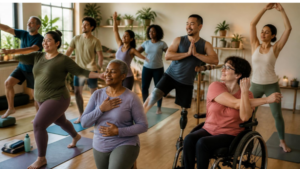
The Global Wellness Institute defines wellness as the active pursuit of activities, choices, and lifestyles that lead to a state of holistic health. Inclusive wellness asks a further question: active for whom, and defined by whose experience?
Inclusive wellness means wellness guidelines, definitions, resources, and businesses are built with the input and ownership of the populations they serve, rather than built around one group’s assumptions about what everyone needs. This especially considers historically underrepresented groups that have been excluded from research, funding, and leadership.
More on Inclusive Wellness
To be considered inclusive wellness, the practices, guidelines, and businesses have to reflect on diversity of identity, thought, experience, need, and practice. It’s in support of wellness businesses owned by and serving historically underrepresented groups.
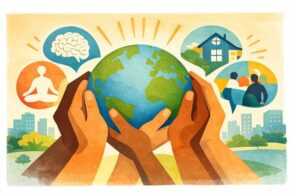
Inclusive wellness is the ongoing work of choosing toward holistic health across every dimension of a life. It’s the recognition that this work looks different depending on who’s doing it and who requires it, and that the field only becomes truly holistic when it makes room for a variety of wellness traditions and methodologies rather than one default version of what “well” looks like.
A Note on Language
Language is a living thing. It shifts as our understanding deepens, as communities reclaim and redefine terms for themselves, and as we learn to hold space for experiences beyond our own.
This glossary reflects our commitment to language that is respectful, accurate, and specific. Many of these terms carry layered histories and different meanings across communities, regions, and generations. A word that feels affirming to one person may feel incomplete to another. Where that’s true, we’ve tried to name the nuance rather than flatten it.
We offer these definitions as context. They’re a starting point for understanding, not a substitute for listening to the people and communities these words describe. If you’re unsure how someone identifies or wishes to be described, the most respectful path is often simply to ask.
This glossary will continue to grow and change alongside the communities it represents. We welcome feedback, corrections, and additions, and we’ll revisit these entries as language and understanding evolve.
How to Begin the Inclusive Wellness Path
Diversity Equity Inclusion Foundations
Access: Fair and equal opportunity for all individuals to participate, contribute, and succeed, regardless of their background or identity. It includes removing often invisible systemic, technological, and cultural barriers that historically exclude underrepresented groups.
Allyship: Continuous practice of using one’s privilege and social influence to advocate for historically underrepresented groups.
Diversity: The presence of differences within a group, including race, gender, age, ability, and other identities.
Equity: Recognition of systemic barriers experienced by historically underrepresented groups to ensure fair and just distribution of resources and opportunities by addressing these systemic barriers and inequalities.
Historically Underrepresented: Populations that have faced systemic disadvantages, exclusion, or discrimination based on race, ethnicity, gender, sexual orientation, disability, or socioeconomic status. (Term used most often by GWI Inclusive Wellness Initiative.)
Inclusion: Creating environments where all individuals are actively involved, valued, respected, and able to fully participate regardless of their background, identity, or abilities.
Marginalized: Communities that have historically been excluded from access, opportunity, and representation due to systemic power imbalances. Marginalized communities refer to groups of people who experience social, economic, and/or political exclusion or discrimination based on characteristics such as race, ethnicity, gender, sexual orientation, socioeconomic status, disability, or religion.
Privilege: Unearned advantages granted to certain groups based on social identity.
Allyship
Ableism: Ableism is a set of beliefs or practices that devalue and discriminate against people with physical, intellectual, or psychiatric disabilities.
Accessibility: Design of products, environments, and services to be usable by everyone ensuring equal access. This can apply to any historically underrepresented groups, but most often used when considering disabled community or removing financial barriers.
Ally: A label given to people by the communities they support who continuously use one’s privilege and social influence to advocate for historically underrepresented groups.
Chronic Trauma: Prolonged or repeated exposure to distressing situations. Historically underrepresented communities experience chronic trauma through repeated microaggressions, code switching, discrimination, and navigated systemic oppression.
Implicit Bias: Everyday subtle and often unintentional interactions or behaviors that communicate some sort of bias towards members of historically underrepresented groups. Used more recently to describe microaggressions.
Microaggressions: Everyday subtle and often unintentional interactions or behaviors that communicate some sort of bias towards members of historically underrepresented groups. (see implicit bias)
Privilege: Unearned advantages granted to certain groups based on social identity.
Racialized: Seeing someone through the lens of race, assumed to be non-white – often leading to unequal treatment. This has taken the place of “visible minority” in some locations.
Identity
AAPI: Asian American and Pacific Islander, umbrella term for Americans with ancestry from the Asian continent or the Pacific Islands of Melanesia, Micronesia, and Polynesia.
African American: Black American with African descent. Often implies descendants of enslaved people. An ethnic group of individuals whose lineage traces back to enslaved Africans brought to the United States.
Biracial: A person with parents or ancestry from two different racial groups.
Black: Racial classification used to describe people with dark skin. More commonly used in America to be more inclusive of Afro-Caribbean, African, and mixed race people. Using Black as an identifier reclaimed the word as a source of empowerment.
Cisgender: A person whose gender identity and/or expression does correspond with their sex assigned at birth. (e.g. A person who was assigned male at birth and identifies as a man).
Colorism: Value determined by pigmentation of skin. Can occur within cultures. Lighter skin is associated with more privilege and higher class. (see shadism)
Disabled: Individuals with physical, mental, cognitive, or developmental impairments that substantially limit major life activities.
Gender Expansive: People who don’t adhere to gender stereotypes.
Gender Fluid: A person whose gender identity and/or expression is not fixed. It can vary over time.
Genderqueer: Genderqueer people typically reject notions of static categories of gender and embrace a fluidity of gender identity and often, though not always, sexual orientation. People who identify as “genderqueer” may see themselves as being both male and female, neither male nor female or as falling completely outside these categories.
Hispanic: Someone from or with ancestors from Spanish-speaking countries. Popularized by the U.S. Census Bureau in the 1970s. Considered ethnicity, not a race. Has racist history to separate light skinned Hispanics from dark skinned Hispanics.
Indigenous: People or communities who are the original inhabitants of a land or region predating colonization or the formation of the current nation-state. Indigenous identity is tied to specific nations, tribes, or peoples rather than a single shared culture (for example, in the U.S. this can apply to Native Americans and Alaska Natives whereas in Canada this can include groups like First Nations, Aboriginal in Australia, or Māori in New Zealand.) Many Indigenous individuals prefer to be identified by their specific nation or tribal affiliation.
Intersex: Intersex people are born with a variety of differences in their sex traits and reproductive anatomy. There is a wide variety of difference among intersex variations, including differences in genitalia, chromosomes, gonads, internal sex organs, hormone production, hormone response, and/or secondary sex traits.
Latino/Latina: A person of Latin American origin or descent. The terms are gendered in Spanish (Latino – male, Latina – female). LatinX and Latine have surfaced as gender neutral options. (see LatinX)
LatinX: Gender neutral term for people of Latin American descent. Linguistic criticism around the term as it’s not properly translated. Latine has been considered a better option, though less widely known. US-centric term. (see Latino/Latina)
LGBTQ+: An acronym for “lesbian, gay, bisexual, transgender and queer/questioning” with a “+” sign to recognize the limitless sexual orientations and gender identities.
Neurodivergent: Describes individuals whose brain functions have natural variations in processing, learning, and experiencing the world (e.g., ADHD, autism). Would be categorized under disabled in some countries including the U.S.
Non-Binary: An adjective describing a person who does not identify exclusively as a man or a woman.
Queer: Queer is often used within the LGBTQ+ communities as a catch-all, including those who do not identify as exclusively straight and/or folks who have non-binary or gender-expansive identities. This term was previously used as a slur, but has been reclaimed by many parts of the LGBTQ+ movement. (commonly used in Canada and the States, less so in other parts of the world)
Questioning: A term used to describe people who are in the process of exploring their sexual orientation or gender identity.
Shadism: Value determined by pigmentation of skin. Can occur within cultures. Lighter skin is associated with more privilege and higher class. (see colorism)
Transgender: A person whose gender identity and/or expression does not correspond with their sex assigned at birth. It can be used as an umbrella term to refer to a range of gender identities and experiences. Being transgender does not imply any specific sexual orientation.
Sexual Orientation
Asexual: A person who does not experience sexual attraction, and/or who has little to no interest in sexual activity.
Bisexual: A person who experiences attraction to both people of their own sex and people of sex different from their own.
Gay: A person who experiences attraction to people of the same sex as themselves. It can be used by individuals of any sex but is often used to refer specifically to males attracted to other males.
Heterosexual: A person who experiences attraction to people of a sex different from their own. Also referred to as “straight.” Included here because naming the majority orientation, rather than treating it as a default, is part of building a vocabulary where all orientations are named on equal footing.
Lesbian: A female attracted to other females.
Two Spirited: Exclusively used by and for people who are Indigenous and also identify as LGBTQ+.
Discrimination
Ageism: The stereotypes (how we think), prejudice (how we feel) and discrimination (how we act) towards others or oneself based on age. Any ism flows one way: from those with social power to those without or with less.
Biphobia: The fear, hatred, discomfort, or mistrust, specifically of people who are bisexual (or those who are perceived to be).
Homophobia: The homophobia definition is the fear, hatred, discomfort with, or mistrust of people who are lesbian or gay (or those who are perceived to be).
Transphobia: The fear, hatred, discomfort with, or mistrust of people who are transgender or genderqueer (or are perceived to be), or who don’t follow traditional gender norms.
Xenophobia: The fear, hatred, discomfort with, or mistrust of people who are from other countries, cultures, or perceived as foreigners.
Additional Resources:
How to Create Belonging in Wellness Uncovering the Unseen