Wellness Real Estate Case Study:
The Spine, Liverpool, United Kingdom
The Spine is a 14-story, state-of-the-art, healthy and sustainable office building, specially designed to serve as the new northern headquarters for the Royal College of Physicians (RCP). Located near Liverpool’s city center, the building is a flagship project within the first phase of the Liverpool Knowledge Quarter’s Paddington Village development—a $1.26 billion (£1b) initiative to create a 30-acre urban village and innovation district focused on life sciences, technology, education and health.
The Spine building was a $49 million (£39m) investment, developed as a collaboration between the Liverpool City Council and RCP, after the latter selected Liverpool to be the home of its new Northern Centre of Clinical Excellence (RCP’s first expansion outside of London in its 500-year history). The overall aim for The Spine was to create one of the healthiest buildings in the world and an iconic design that evokes a narrative of the human body and the pioneering work of RCP—while simultaneously being a “backbone” for the longer-term development of a life sciences innovation district in Liverpool.
As the anchor tenant, RCP occupies seven floors of The Spine, with purpose-built spaces that accommodate its main activities—i.e., delivering bespoke, high-stakes postgraduate examinations to clinical professionals from across the healthcare landscape, both in the United Kingdom and internationally. The RCP spaces include facilities for research, medical training, examinations and conferencing, with open-plan office spaces and meeting/conference rooms, as well as a ground-floor public café and informal events space. The other floors in the building provide flexible workspaces for like-minded industries, conference/exhibition and dining/entertainment spaces for hire, a large bicycle storage and shower facility, and undercroft parking.
Distinctive approaches to wellness
Designed from the ground up to be a health-enhancing building that exceeds WELL Platinum standards
When the GWI research team toured The Spine, Rob Hopkins (lead architect for this project) noted he was “given a blank canvas” with a simple mission: to design the healthiest building possible, in order to represent the RCP’s core values and its credibility in medicine. Hopkins said his goal was to design a building where people are healthy, happy and productive, so that they walk out feeling healthier than when they arrived. The design team chose the WELL Building Standard to support the project’s mission, ensuring that multiple aspects of wellness (air, water, nourishment, light, movement, thermal comfort, sound, materials, mind and community) informed all building design decisions from the earliest stages.
In fact, according to Hopkins, this project introduced a whole new design process, whereby every proposed feature was discussed with the client (i.e., physicians from RCP) and benchmarked against research-supported evidence. The wellness design process was made easier by incorporating certification standards into the building design from the start, as opposed to adding it later. Hopkins estimated that building to WELL standards added only 2% to the cost—excluding the cost of plants.
The project also aimed to go beyond the certification requirements, and it succeeded in doing so. Upon completion, The Spine earned 109 out of 110 WELL Version 2 Pilot points, one of the highest scores of any WELL building in the world, and well beyond the 80 points required to achieve a Platinum rating. Since opening, the on-site workplace manager has made an effort to educate workers and visitors about the building’s healthy features by adding signage throughout the building, posting educational materials on the RCP intranet and incorporating information into conference/events materials.
The Spine’s WELL Platinum certification and health-enhancing features are complemented by its many advanced sustainability features. The building has earned a BREEAM Outstanding rating, thanks to its energy efficiency via smart building-management systems and sensors, the use of natural, sustainable and recycled materials (e.g., flooring made from recycled plastics) and recycling and waste reduction practices that mitigate the environmental impact of its operations, including food menus based on seasonal and locally sourced ingredients.
Building a visual representation of the human body
The Spine draws on a narrative of the human body and its abstract representation as the key design concept—features that not only support its mission to be a healthy building but also evoke the world-leading work of RCP as its main tenant.
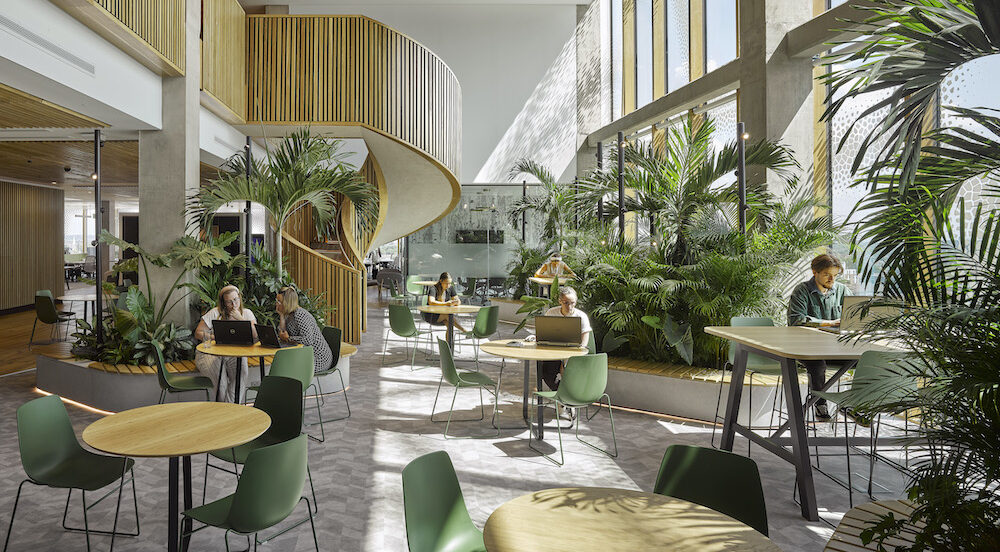
The building takes its name from the striking geometric staircase on its north side, which resembles the human vertebrae. The staircase offers panoramic views across Liverpool, encouraging people to use the stairs. In the atrium on the upper floors, the double-story sky gardens, filled with high-oxygen-producing plants, represent the “lungs” of the building. On the ground floor, exposed concrete columns are molded to reflect the trabecular system within human bones, which is the strongest part of a bone for load bearing, shock absorption and regeneration. The distinctive design on the building’s fritted glass façade or “exoskeleton” utilizes 23 million individual polygons applied in a Voronoi pattern that can be found in human skin cells, while the ground-floor café ceiling pattern mimics a protein cell structure. In addition to its biological symbolism, this biomorphic design element provides several health-enhancing biophilic benefits—as described in more detail below—in addition to controlling solar heat gain.
Innovative expressions of biophilia to support occupants’ health and wellbeing
The Spine uses a sophisticated and in-depth application of biophilic design principles, with features that go far beyond the typical approaches of green plants and natural light. The building’s designers conducted a survey of RCP staff about their work and needs, using this data to thoughtfully select five or six specific biophilic design patterns (based on Terrapin Bright Green’s 14 Biophilic Patterns, that would have the greatest, evidence-based impact on the physical and mental health and wellbeing of the building’s users.
For example:
- Natural Analogues: In the biophilic patterns, the Natural Analogues principles focus on using organic materials, patterns and textures in the built environment to evoke a connection to nature. The Spine thoughtfully delivers these principles through its biomorphic design narrative inspired by the human body (see discussion above), which appears throughout the building. The extensive use of wood, clay and other natural materials throughout the interior fittings and furnishings provides a visual and tactile connection to nature. Sustainably sourced wood is used throughout flooring, ceilings, walls and furniture. Clay plaster was specifically chosen for acoustic absorption in the ceiling because it is a natural material that also helps to balance humidity. All the interior designs subtly mimic the color palettes and repeating patterns found in nature, which have a naturally calming effect on the mind. Echoing a tree rising through the building, an earthier color palette on the lower floors merges into greener, leafier colors and patterns, and then to blue tones on the upper floors.
- Nature in the Space: The Nature in the Space biophilic principles emphasize bringing natural elements (e.g., plants, water, light, sounds, scents) directly into spaces. Like many healthy buildings, The Spine brings direct, physical elements of nature into the indoor environment via its extensive use of indoor plants (especially in the upper floor sky gardens and ground floor plant wall), as well as its floor-to-ceiling windows to maximize exposure to natural light and provide a visual connection to nature.
The building’s most unique element is the biomorphic Voronoi patterns etched onto its exterior glass windows, which simultaneously address several biophilic principles (Dynamic & Diffuse Light, Connection with Natural Systems, Biomorphic Forms & Patterns, Complexity & Order). When the sun shines on the building, the interior spaces are bathed in dappled internal shadows that shift throughout the day, reminiscent of a forest canopy and the Japanese practice of forest bathing. This dynamic, changing natural light brings awareness of natural systems and seasons, and helps occupants synchronize their circadian rhythms—all in a much more cost-effective and natural way than investing in a high-tech circadian lighting system for the whole building.
To learn more about this case study and others, see GWI’s report, Build Well to Live Well: Case Studies, Volume 1.