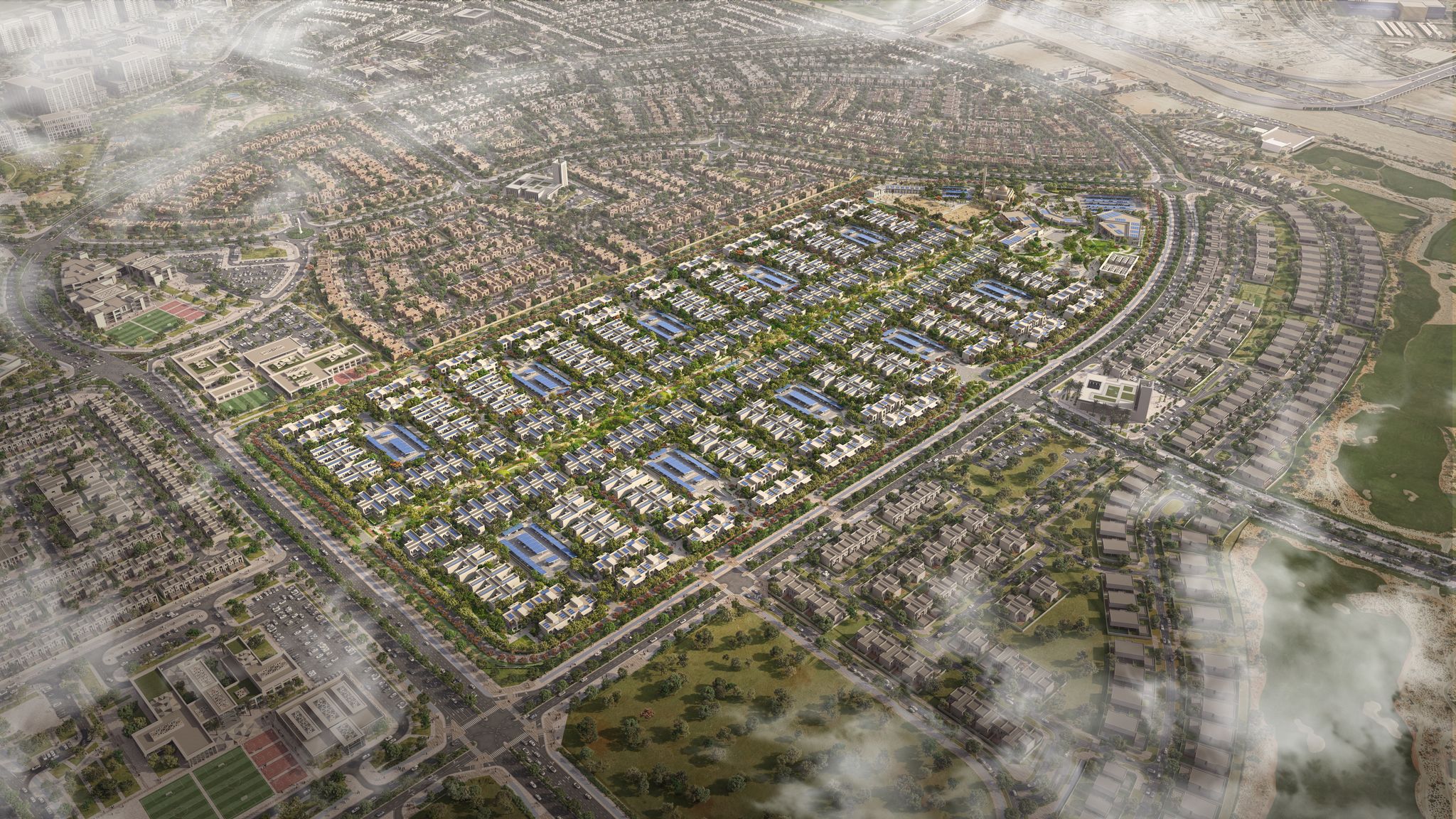
The Sustainable City Yas Island––Yas Island, Abu Dhabi, United Arab Emirates
The Sustainable City Yas Island (TSCYI) is 98-acre/396,600-sq.m. master-planned community located in north Yas Island, about 22mi/35km northeast of downtown Abu Dhabi. As the first “Sustainable City” community developed in Abu Dhabi, TSCYI promises to support a new way of life for its 3,500 residents by delivering a living environment that is health-enhancing and environmentally sustainable. TSCYI has set a new development benchmark for the region by being the first project in Abu Dhabi to achieve an Estidama 3-Pearl PCRS (community rating) and 5-Pearl PVRS (villa rating)—far beyond the 1-Pearl requirement mandated by the government for all new development projects. TSCYI will deliver 864 homes of various sizes and price ranges, with handover beginning in May 2026. The project, and the lifestyle it offers, have found a ready market in Abu Dhabi. Phase 1 residences sold out in less than 24 hours in 2023, with one-bedroom apartments priced at $245,000+ (AED900,000+) during pre-sales and rising to $435,600+ (AED1.6m+) for resales within three years.
TSCYI is a collaboration between Aldar Properties and Diamond Developers. Aldar Properties is the master developer of the overall Yas Island project, where TSCYI is located. Yas Island is a massive, 6,180-acre/25-sq.km. man-made island that was designed to be a premier entertainment and tourism destination, and the entire island has earned LEED Communities Platinum certification. It features residential areas, beaches, hospitality, leisure, shopping, and entertainment facilities—including several theme parks, a Formula 1 racetrack, and the largest mall in Abu Dhabi. As a leading developer in Abu Dhabi, Aldar is committed to accelerating sustainable development in line with the UAE’s Net Zero by 2050 Strategic Initiative. Diamond Developers (Dubai-based) is widely recognized for pioneering sustainable, net-zero energy communities in the UAE and the Middle East. Operating as a subsidiary of SEE Holding, the company focuses on creating “live-work-thrive” environments that prioritize social, environmental, and economic sustainability. Diamond created “The Sustainable City” model and opened The Sustainable City Dubai in 2015 as the first operational net-zero city development in the Middle East. In addition to TSCYI, Diamond is currently developing other new Sustainable Cities in Sharjah and Oman. TSCYI and the other new projects build upon the strengths and lessons learned from the Dubai project.
Distinctive approaches to wellness
A human-centric community that values car-free mobility, inclusiveness, and diversity.
A distinctive characteristic of TSCYI is its people-first, car-free design, which is a departure from typical Abu Dhabi neighborhoods, and which is a critical factor to deliver on its social, environmental, and economic sustainability goals. TSCYI is designed as 10 residential clusters, each with its own parking area accessed via a ring road on the perimeter of the site. From there on, cars cannot enter the development, and residents can walk, ride bicycles, or use electric buggies for mobility within the community. The residential clusters are linked by a series of uninterrupted, tree-shaded pathways and sikkas (traditional alleyways between buildings) to a central “green spine” that runs across the entire development. On one end is a mixed-use district, which includes a central plaza, food & beverage, retail, a supermarket, a pharmacy, a nursery school, a fitness club, a community swimming pool, sports courts, equestrian stables and arena, an animal sanctuary and pond, and other amenities—all within a five-minute walk from every residential unit. A mosque is located at the other end of the development.
This car-free design encourages active transit and natural physical activity, and along with the expansive and attractive public realm and green spaces throughout the development, it facilitates social interactions among neighbors. With the variety of housing options (from one-bedroom condos to four-bedroom townhomes), TSCYI residents will be diverse in terms of ages, household sizes, and income levels. Mobility for all demographics is an important consideration at TSCYI. The pedestrian-first design and the cycling/jogging tracks allow all residents, including young children and those with physical disabilities, to move freely, safely, and independently within the development. TSCYI also provides a geofenced fleet of 75 electric buggies, operated via mobile application, which will support mobility for diverse age groups while maintaining low-speeds and safe internal circulation.
TSCYI is intentionally designed to be welcoming to People of Determination (the term used in the UAE for people with disabilities) and those with neurodiversity. In early-2024, Aldar Properties and the Abu Dhabi Department of Community Development formed a partnership to launch the People of Determination and Elderly Inclusive City Project on Yas Island as a pilot project1, and many initiatives are underway to transform the public realm, including malls, schools, mosques, and beaches. In addition, there are preliminary plans for an Autism Center on the grounds of TSCYI, which will include classrooms and rooftop gardens, designed for comprehensive care, specialized education, therapy, and enrichment. In the Dubai project, the community-oriented atmosphere, the ample and quiet green spaces, and the calming natural elements (parks, animals, etc.) have made Sustainable City an especially welcoming place for those with autism and neurodiversity, and the same is expected for the Yas Island project.
A holistic and system-wide approach to creating a sustainable and healthy community.
The design and operations of TSCYI are guided by The Sustainable City model and Abu Dhabi’s mandatory green building design and rating system, Estidama. Founded by Diamond Developers/SEE Holding, The Sustainable City is a framework and a replicable model for achieving net-zero emissions communities based on three intersecting pillars of social, environmental, and economic wellbeing.2 Estidama (Arabic for “sustainability”) and its green building “Pearl Rating System” were designed for the unique conditions in the Gulf region: intense sun, extreme heat, scarce water, and a reliance on energy-intensive cooling and desalinization systems. In addition to reducing water consumption and increasing energy efficiency, the Estidama framework emphasizes creating livable spaces, protecting local ecosystems, and using sustainable materials, and it requires an integrated development process and innovative practices in its minimum rating requirements.
From the outset, TSCYI has set out to exceed the mandatory Estidama requirements in Abu Dhabi (1-Pearl) and excel in its realization of the Sustainable City model. Concrete, measurable targets regarding energy, water, food, mobility, waste, and material use are incorporated into its master plan. These objectives will be delivered in the form of a walkable, car-lite community; high-quality public realm; resource-efficient systems; and social wellbeing amenities. With such a comprehensive scope, actors across multiple disciplines—including urban planning/design, transport, utilities, sustainability, and environmental specialists—are collaborating and coordinating across all project stages, from design and planning to delivery and operations. This holistic, system-wide approach made it possible for TSCYI to adopt important innovations, such as the first community-scale solar in Abu Dhabi. All rooftops in the development will be equipped with high-performance solar panels that will drastically reduce energy demand and costs, with a target of 50% savings for residents on utility bills. To conserve energy and water, all homes are installed with energy-efficient appliances and low-flow water fixtures. Smart-home automation systems will help to optimize energy usage, while high-thermal-efficiency building materials keep interiors cool with less need for air conditioning. The community parking garages are also covered with solar PVs that can power up to 35% of the energy use of the district cooling plant.
A holistic and system-wide approach allows for the planning of community elements to maximize both wellbeing and environmental benefits. Landscaping is not just ornamental but also a vital workhorse that supplies strategic and maximum shading, improves stormwater drainage, enhances biodiversity, sequesters carbon, creates an attractive public realm, and harnesses the wellbeing benefits of nature, while being fed by recycled greywater under an advanced irrigation system and smart monitoring. With food being a priority for health and wellbeing, three professionally managed biodomes along the green spine will produce 50tons/45,000kg of chemical free vegetables annually for community consumption, using advanced hydroponics and vertical farming methods. Community farming plots are also planned for the multiple pocket gardens across the development, allowing residents to grow their own produce. In addition to reducing food miles, these food-producing elements will support healthy eating, enable educational activities, build nature connections, and cultivate community through shared activities.
Climate-adaptive design that delivers comfort and sustainability goals.
TSCYI has adopted a number of passive design features that help modulate high temperatures and sun exposure, in order to improve residents’ thermal comfort while also reducing energy demand for cooling. All trees and plant species are selected for their native climate adaptability (high heat tolerance and low water requirements) and their ability to provide shade. Building orientations are optimized to reduce solar heat gain. The tightly clustered homes and staggered terraces pay homage to traditional Arabic neighborhoods while also creating natural shading from the sun. The narrow sikkas that run between the buildings are enhanced with trees to maximize shade for walking and outdoor recreation. Pergolas over windows, doors, and public parks/plazas are used to provide additional shading while allowing natural, filtered light to pass through. All residences at TSCYI are designed to open toward the north to maximize shade and facilitate airflow for natural cooling. Windows are sized and positioned to optimize the balance between natural light and heat gain, with high efficiency and low U-value glazing to further minimize heat transfer to indoors. Light-colored and reflective paints and materials are used on all surfaces, to reduce heat absorption. Envelope efficiency through air tightness, light/shade control, thermal insulation, etc. is expected to produce energy savings of up to 40% in the community. Asphalt-free and permeable surfaces help with stormwater management while also reducing the urban heat island effect. Across the community, all of these design features are expected to lower the temperature by up to 5°C on the hottest days. It should be noted that these passive cooling designs are prioritized under the Estidama rating system, which has more stringent requirements for passive design to reduce energy and water consumption as compared to systems such as LEED and BREEAM.
A successful and replicable model for healthy and sustainable development.
A unique aspect of TSCYI is that it is based on a replicable and scalable model that has already gone through several iterations, and that can be adapted to many different geographic settings because it does not depend upon location-specific assets for its value proposition. The first Sustainable City project in Dubai (TSC Dubai) was initially launched in 2010 and opened in 2015. It was a novel and pioneering project—the first fully-realized sustainable residential community in the Middle East, at a time when sustainability technologies were not yet well-developed or widely available. The Dubai project aimed to debunk the idea that sustainability has to come at a high price, cannot be economically viable, or requires tradeoffs to quality of life. It also overcame much skepticism about whether a car-free community would appeal to buyers. As an early player in this space, the project had to strike a careful balance between low-tech and high-tech approaches, selecting sustainability technologies that were functionally and commercially practical and that would not reduce its economic viability. The goal in Dubai was to create not a modernist, tech-heavy “city of the future,” but rather a livable, social, organic, and nature-based community that would make people want to live there, whether they were personally committed to a sustainable lifestyle or not. Now a decade into its operations, TSC Dubai has demonstrated the success of its model across all three of its pillars (environmental, social, and commercial):
- The Dubai project is now a thriving multigenerational community of over 3,000 residents, and it has been recognized as the “Happiest Community in the GCC” at the Gulf Real Estate Awards for several years. The community has been at 100% occupancy (with a waitlist) since the pandemic, and units are now selling at a significant price premium because it is such a desirable place to live. Strong word-of-mouth advertising and media exposure have allowed Diamond Developers to avoid any spending on advertising and marketing the project.
- A study led by UC-Davis and the American University Cairo tracked residents over three years as they moved into TSC Dubai (2015-2018) and found several positive impacts on their wellness and social behaviors. For example, many residents reported reducing their car usage, increasing their physical activity, and adopting new sustainability habits since moving to TSC Dubai. Over 82% of those surveyed said they know at least one of their neighbors (and 26% know more than 11 neighbors), and many stated that their degree of interaction with neighbors was much higher than where they lived previously. Over 84% stated that living in TSC Dubai provides a sense of community.3
- Environmental achievements in Dubai include a 78% lower carbon footprint per capita, 89% waste diversion from landfills, 100% wastewater recycling, 40% less water consumption than regional averages, and per capita greenhouse gas emissions well below the Dubai average.4
- A holistic assessment of TSC Dubai’s construction costs has shown that it did not cost appreciably more to build than a conventional development. While some sustainability components (e.g., rooftop solar panels, highly efficient HVAC systems) did require higher expenditures, these have been easily offset by savings in other areas (e.g., not needing to build underground stormwater infrastructure because water is managed by careful grading, site planning, permeable paving, and other “sponge city” features). In operations, residents have benefitted from lower energy and water bills, as well as zero service and maintenance fees (because rental income from the shops, restaurants, and commercial properties in the mixed-use town center has covered the ongoing maintenance needs of the entire community).
Following on the success of the Dubai project, new Sustainable City projects have been launched in Sharjah (2019), in Oman/Yiti (2022), and in Abu Dhabi/Yas Island (2022), and future sites both within and outside the Middle East are under consideration. While the overall ethos, focus on environmental, social, and economic sustainability, and key design concepts and amenities have remained the same, the approaches in each location have also evolved to reflect lessons learned, the evolution of new technologies, and unique location-specific factors and needs. For example, at TSCYI, smart irrigation technologies for water management have been built in from the outset (while this tech was not available when the Dubai project was initially built). The TSCYI master plan has made other changes such as putting parking decks on two levels—a design shift that creates full, physical separation between parking and the walking/cycling paths, increasing safety for children. In both Dubai and Yas Island, the plans stipulate a maximum walking distance of 300ft/90m from parking decks to homes, but the Yas Island plan has reduced the number of homes at that distance. Different regulatory environments have also required different approaches to solar power and energy management. For example, Dubai allows for net metering, while Abu Dhabi does not, meaning that TSCYI uses a different approach (connecting residents’ rooftop PV directly to the project’s district cooling plant to offset their energy bills, rather than getting credits through the grid); meanwhile, the Oman/Yiti project is able to use solar power more extensively and is likely to achieve 100% renewable energy and net-zero emissions. As sustainability technologies continue to evolve, and as the model is customized to different regions, further adaptations will be implemented, such as using battery storage so that projects can be entirely off-grid or creating designs that can be sold at more affordable price points. Future iterations of the Sustainable City model are looking to embrace AI-driven, resilient smart systems and resource management, freeing up the city’s design to become even more human-centric, connected, and wellness-driven.5
To learn more this case study and others, see GWI’s 2026 report, Build Well to Live Well: Case Studies, Volume 2.