Wellness Real Estate Case Study:
The Spine, Liverpool, United Kingdom
Sports Boulevard, Riyadh, Kingdom of Saudi Arabia
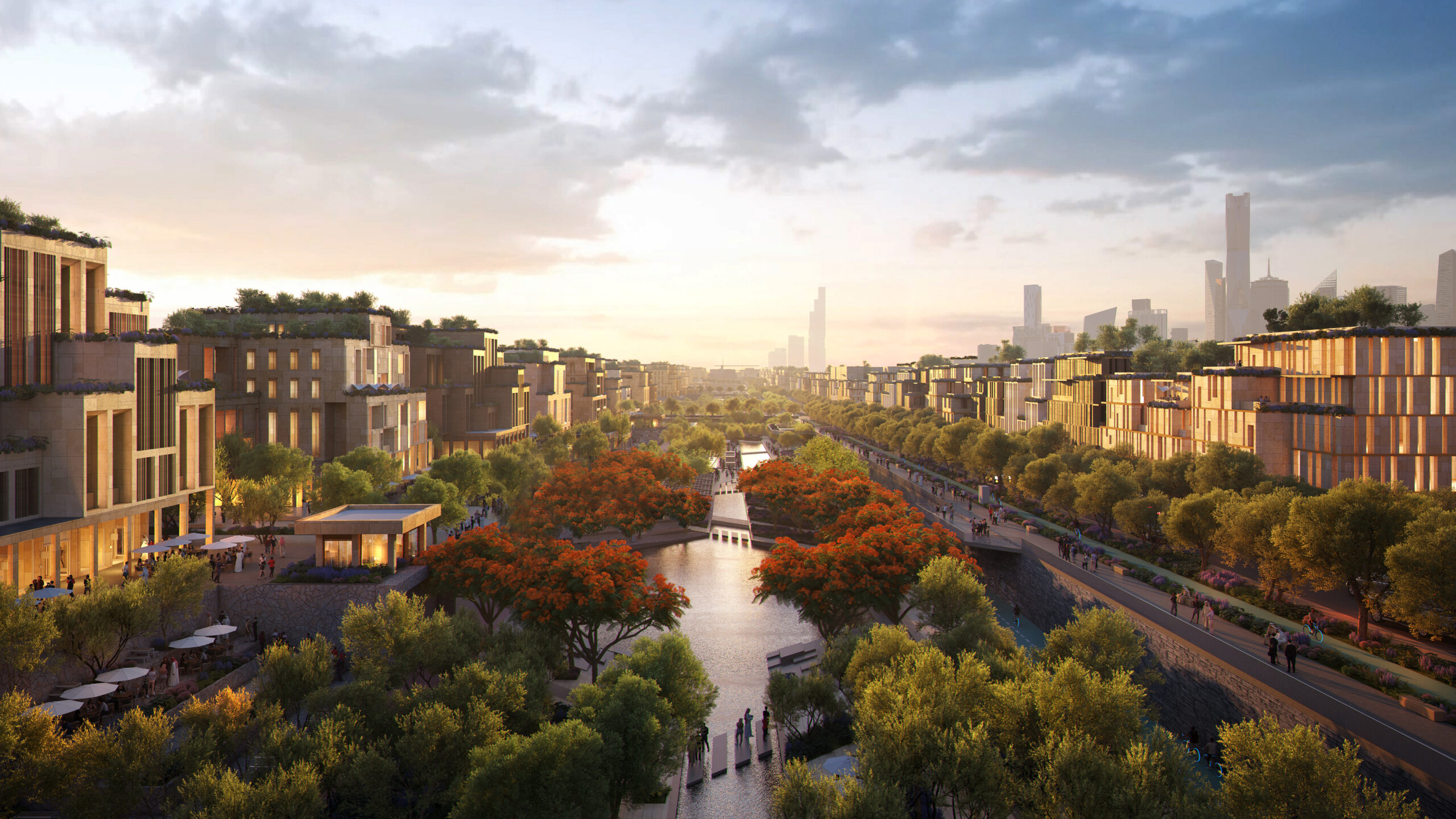
A linear park designed as a vast, new, green public realm for active transit, outdoor recreation, sports, arts and entertainment, surrounded by curated retail, residential and commercial zones.
The Sports Boulevard is an 84+mi/135+km linear park crossing the entire city of Riyadh, a transformative urban redevelopment project that is building a new, healthy public realm accessible to the city’s entire population. Initially launched in 2019, it is one of several Riyadh mega-projects aiming to foster a culture of health and wellbeing and to make the city one of the most livable and green cities in the world. Considered to be the largest linear park in the world, it is expected to have wide-ranging impacts for Riyadh’s population, social fabric and economy, in addition to contributing to urban greening and sustainability goals. Phase 1 of the project (51mi/83km of the park and five destination areas) opened in February 2025.
The Sports Boulevard features several innovative approaches to human health and wellbeing:
- Bringing radical transformation in mobility, connectivity and accessibility for an entire city.
- Building a new and inviting public realm for multidimensional wellness.
- Using a design code to ensure harmonious, locally rooted and sustainable public and mixed-use development.
Sports Boulevard, Riyadh, Kingdom of Saudi Arabia
The Sports Boulevard is an 84+mi/135+km linear park crossing the entire city of Riyadh, and a transformative urban redevelopment project that is building a new, healthy public realm accessible to the city’s entire population. Initially launched in 2019, it is one of several Riyadh mega-projects aiming to foster a culture of health and wellbeing and to make the city one of the most livable and green cities in the world.1 The project also supports Saudi Arabia’s Vision 2030 and broader governmental efforts to encourage healthy lifestyles, quality of life, sustainability and diversified economic development. Sports Boulevard’s vision is to create innovative and sustainable regeneration via a green spine running across Riyadh, in order to connect the city, enable wider sports adoption and improve quality of life.
The centerpiece of Sports Boulevard is a series of multimodal pathways (84+mi/135+km of pedestrian paths, 137mi/220km of cycling paths and 9+mi/15+km of horseback riding trails), which will promote healthy movement and connectivity across the city and will connect to other major districts, landmarks and public transit options. The Sports Boulevard project also encompasses 990 acres (over 4 million square meters) of new green and public spaces, more than 50 sports facilities and 32.3 million square feet (over 3 million square meters) of mixed-use private development (retail, food & beverage, residential, office, etc.). The project is developed and managed by the Sports Boulevard Foundation, with major investment zones developed in partnership with the private sector. Considered to be the largest linear park in the world, it is expected to have wide-ranging impacts for Riyadh’s population, social fabric and economy, in addition to contributing to urban greening and sustainability goals. Construction began in 2019, and Phase 1 of the project (51mi/83km of the park and five destination areas) opened in February 2025.
Distinctive approaches to wellness
Bringing radical transformation in mobility, connectivity and accessibility for an entire city
Just a decade ago, Riyadh was a traffic-congested city with little public transit and few sidewalks—a car-dependent and sprawling development pattern that had followed the city’s rapid growth and modernization since the 1950s. Prince Mohammed bin Salman Road (previously known as Prince Saud bin Muqrin Road) was a high-speed, high-traffic, multi-lane road that bisected the city and served as a major utility corridor, with massive electrical lines and storm drainage infrastructure. Ranging from 574 to 820 feet wide (175m-250m), the road was a huge barrier to walkability, with only eight crossing points along its 18mi/30km length. The goal for the Sports Boulevard project was to radically transform this vehicle-dominated corridor by burying the power lines and diverting the utilities; reducing the traffic lanes; reclaiming the space for people; connecting it to other key transit routes and natural Wadi parks; and creating a new, continuous green spine for active mobility and outdoor recreation serving the entire city.
With the opening of the first 51mi/83km in February 2025, the Sports Boulevard has already achieved a profound change in the city’s infrastructure for people-first mobility and connectivity. Upon full completion, the 84+mi/135+km-long park will provide a seamless active transit artery that runs across the entire city from the Wadi Hanifa in the west to the Wadi Al-Sulai in the east. It passes by many of Riyadh’s major residential and commercial areas, and it connects to many other major development projects and landmarks, including the Diriyah destination and new Diriyah Gate project, Misk City, King Abdullah Financial District, Princess Nourah University and King Fahd Stadium. The Sports Boulevard will be within walking or cycling distance of millions of Riyadh residents. The new, six-line Riyadh metro system opened in November 2024, and the Sports Boulevard connects directly to three metro stations—leveraging the city’s $23 billion (SAR84.4 billion) investment in public transit with new active transit and micromobility options that will allow people to travel across the entire city without using a car. This major change in the urban landscape provides many wellness benefits, from encouraging daily movement to reducing the time and mental stress of sitting in traffic, in addition to addressing sustainability goals. In 2024, the Sports Boulevard became the first development in the world to obtain ActiveScore Communities Platinum certification, recognizing its world-class infrastructure for active mobility.
The Sports Boulevard is carefully designed to be safe, accessible and welcoming for all segments of the population, from children and families to elite athletes. Traffic calming measures—such as reducing the number of car lanes, shifting traffic patterns, eliminating service roads and increasing crosswalks—have made space for active transit and recreational pathways to run in parallel with the existing roadway and have added pedestrian connections across a previously impassable high-traffic corridor. There are safe, easily accessible and separated pathways for walking, amateur cycling, professional cycling and horseback riding. The project has also prioritized design that is inclusive and accessible to all visitors, including those with physical disabilities.
Building a new and inviting public realm for multidimensional wellness
Historically, Riyadh lacked green spaces, parks and public spaces for recreation and socializing.2 In addition to enabling active mobility, the mission of Sports Boulevard is to “create a sports and wellness ecosystem that inspires residents and visitors to pursue a healthy and active lifestyle.” The project is building a 990-acre (over 4 million square meters) network of new green and public spaces for wellness, play, nature, arts, culture and community, which run the entire length of the 84+mi/135+km linear park and represent a 62% increase in green space per capita. The Sports Boulevard master plan divides the project into diverse destinations, each with its own theme, unique experiences and facilities for different types of activities—and despite its name, these facilities are not just for sports but also encompass the arts, culture, sustainability and more. Some of the themed destinations include the following:
- The Wadi Hanifa Destination (12.4mi/20km at the western end of the project) runs through a historic, natural ravine that crosses the western side of Riyadh, leveraging ongoing initiatives to rehabilitate the Wadi and transform it into a greenway and a recreational asset for the city, with pathways for walking, cycling and horses.
- The Promenade offers a variety of stations and amenities, including cycle repair, green spaces, playgrounds, retail, comfortable benches and water features. It is distinguished by the Cycling Bridge, an architectural marvel stretching over 0.5mi/900m and connecting the Promenade with Wadi Hanifa, providing safe passage for both pedestrians and cyclists. It is complemented by a picturesque pedestrian bridge that offers sweeping views of the surroundings.
- The Urban Wadi Destination (2.8mi/4.5km) will be home to a low-flow water canal surrounded by lush greenery, offering kayaking activities for visitors. It will also offer many shops and restaurants cooled by a large shading structure (2.5 acres/10,000 square meters), picnic areas, shaded play areas for children, multiple sports courts and pathways for pedestrians and cyclists. The canal water will be constantly recirculated and used in fountains, to provide natural cooling for the area.
- The Arts Destination extends over 0.7mi/1.2km (with a total area exceeding 5.6 acres/23,000 square meters), forming a landmark creative development that blends art and nature. It features the Arts Tower, one of the iconic landmarks of Sports Boulevard. The Grove is designed as a modern, integrated destination incorporating water features and green spaces, alongside children’s play areas and shaded zones to ensure visitor comfort. The destination also offers diverse retail outlets, as well as pedestrian and cycling paths.
- The Entertainment Destination (1.9mi/3km) will have an amphitheater and a complex for performances, as well as several hillside playgrounds, parks and open spaces equipped with shading and passive cooling features for the summer season.
- The Athletics Destination (2.5mi/4km) will offer Olympic-level venues for both elite athletes and amateurs. This district includes the landmark Global Sports Tower, a high-rise building (900,000-square feet/84,000 square meters internal area) with a velodrome, indoor/outdoor sports courts and training areas, and more than 30 facilities for various types of sports.
- The ECO Destination (9.3mi/15km) features areas for plant cultivation, including several fields and greenhouses for seed development, agricultural products and organic food production. It also offers outdoor picnic areas, a culinary arts center, amateur/professional cycling pathways, four cycle service stations and private investment areas.
- Sand Sports Park (at the eastern end of the project) offers a 4,200-acre (17 million square meters) adventure and recreational zone situated among rehabilitated sand dunes. Key facilities include a 28mi/45km cycling pathway in the shape of a Najdi flower (for professionals and beginners), along with cross-country biking trails and BMX. In addition, there are equestrian trails, pedestrian pathways, hiking trails and jogging pathways; several service stations, retail outlets and coffee shops; and an info point.
The destinations along the Sports Boulevard are designed to reflect the local landscape. While the Sand Sports Park has a desert terrain, some of the other destinations are designed to be lush and green. More than 170,000 new native and climate-adapted trees and plants are being planted throughout the project to provide shade, mitigate heat and improve air quality. Vibrant and artistic lighting features are installed throughout the project to create a safe and welcoming environment at nighttime (since outdoor activities tend to take place after dark for much of the year, due to Riyadh’s hot climate). Public art installations also create an inviting public realm. One landmark piece that opened in Phase 1 was the Arts Tower, an artist-designed rendition of the high-voltage electricity towers that once ran along the route, with distinctive and colorful geometric panels that reflect the light. Most of the public facilities along the Sports Boulevard are open 24/7 (for free), and they will be activated with events and activities throughout the year. Since Phase 1 opened, the Sports Boulevard has launched Ramadan events and a wide variety of sporting tournaments and events (walking, running, cycling, badminton, table tennis, martial arts, etc.). It’s clear that the Sports Boulevard is already meeting pent up demand for more outdoor public spaces and facilities for sports and recreation in Riyadh. Within one month of its February 2025, opening, the project had already received one million visitors.
Using a design code to ensure harmonious, locally rooted and sustainable public and mixed-use development
The scope of Sports Boulevard is much more than just the linear park, multimodal pathways and public recreational spaces. The project also includes 32.3 million square feet (over 3 million square meters) of new mixed-use private development and investment opportunities in the spaces and buildings encompassing and surrounding the Sports Boulevard and its themed destinations. Private sector participation is a key enabler of Sports Boulevard’s vision. Private development plots along the project are allocated and planned to deliver approximately 5.6 million square feet (520,000 square meters) of retail space; 4.9 million square feet (460,000 square meters) of office space; and more than 37 million square feet (3.5 million square meters) of residential, hospitality, leisure and entertainment uses. To unlock this potential, Sports Boulevard Foundation established the Sports Boulevard Development Company (SBDC) as its dedicated investment arm, to attract capital and partner with local, regional and international developers. As of 2025, SBDC has already announced partnerships valued at more than $1.6 billion (SAR6.1 billion) for the development of private plots within the Arts District and the Urban Wadi. These partnerships help attract private capital to support the delivery of key projects and contribute to Vision 2030’s objectives.
One of the challenges the Sports Boulevard project faced from the start was the many existing urban planning and design problems along the project site, such as the lack of consistent sidewalks or connections between buildings, poor zoning codes, a lack of an identifiable or local character and the prioritization of vehicles over pedestrians. The Sports Boulevard Design Code was established to address these problems, and to ensure that the design, planning and execution of the entire project creates a unified, elevated, modern and sustainability-driven public realm that will elevate quality of life for Riyadh’s residents and visitors. Launched in July 2022, the Design Code provides detailed architectural and urban planning regulations and standards for all developments along and surrounding the Sports Boulevard. It follows the principles of Salmani architecture, to ensure that the project has a distinctive local identity and to blend authenticity with modernity. The Design Code encompasses a series of manuals that cover different regulatory zones, or transects, with different requirements applied to different types of land plots. The regulations cover architecture and façade designs, land use, building heights, setbacks, massing, materials, color palettes, parking, connectivity, lighting, landscaping, street trees, signage and more. Developers must obtain approval from the Design Code Studio as part of their permitting process. The Sports Boulevard Foundation also encourages all properties surrounding the project to design with active mobility and sustainable transit in mind, and it encourages developers to seek ModeScore or ActiveScore certifications for their projects.
In addition to the Design Code, the Sports Boulevard Sustainability Manual establishes mandatory standards for sustainable design and construction for all developments surrounding the project, focusing on carbon footprint reduction, water use, waste and materials, and mobility. For example, all development plots immediately adjacent to Sports Boulevard are required to connect to the project’s district cooling system. The manual also mandates sustainability certifications for all private developments along the Sports Boulevard (LEED or Mostadam “Gold” at minimum for plots immediately adjacent; Mostadam “Green” or equivalent for plots further away). In 2024, the Sports Boulevard Foundation won the “King Salman Charter for Architecture and Urbanism” award, recognizing its leadership in implementing the Design Code to integrate authentic Salmani design, human centered urban planning and an ethos of sustainability.
To learn more about this case study and others, see GWI’s 2026 report, Build Well to Live Well: Case Studies, Volume 2.