The Biological Basis of Male Social Dynamics
Opening
What is the measure of a man? Online and political discourse has distilled it down to a remarkably narrow profile: sexual conquest, financial dominance, and physical size. These attributes — storied in the folk biology of the manosphere — reduce male identity to a testosterone-centric physiology in which social dominance is the sole axis of variation, as well as the ideal goal of an ideal man’s life.
The current reductionism of masculinity has found appeal amongst young men in the developed world, who are contending with a widening deficit of direction and belonging. Across the OECD, 55 percent of women aged 25 to 34 now hold a tertiary degree, compared to 42 percent of men — a 13-point gap that continues to widen, and young men are more likely than young women to lack an upper secondary diploma (OECD, 2025, “Education…”). In the labor market, the share of young American men neither in school nor in the labor force doubled between 1990 and 2024, from 4 to 8 percent (Reeves et al., 2025), and comparable patterns of rising male economic inactivity have appeared across the UK and EU. Membership in trade unions, religious congregations, and civic organizations has declined across the developed world over the past four decades (Putnam, 2000), and the institutions that remain draw disproportionately from the college-educated population that young men are increasingly absent from.
The withdrawal from educational, occupational, and civic life manifests subjectively as loneliness. In at least 10 OECD nations, one in five men aged 15–34 now reports feeling lonely “a lot of the previous day” (OECD, 2025, “Social…”). Men account for roughly three-quarters of suicides worldwide (GBD 2021 Suicide Collaborators, 2025). Lonely men are not only a danger to themselves; they can be a danger to others. Reviewed experimental evidence indicates that social exclusion increases endorsement of extreme political violence across gender (Pfundmair et al., 2022). Among men, the loneliness-to-violence pathway has an unsettling empirical record: mass shooters motivated by sexual frustration and social rejection are overwhelmingly young, male, unmarried, and unemployed (Lankford & Silva, 2024), and the incel-attributed attacks documented since 2014 share this demographic profile (Hoffman et al., 2020).
Existing Accounts
Several frameworks have attempted to explain these patterns, each capturing part of the picture. Putnam’s social-capital thesis (2000) documented the erosion of civic institutions — bowling leagues, Elks lodges, union halls — and showed that their decline correlates with deteriorating social trust and community engagement. Eberstadt (2022) demonstrated that prime-age male labor-force dropout has reached Depression-era levels despite abundant job openings, with marriage the strongest demographic predictor of whether a man works: married men without a high school diploma participate at rates comparable to unmarried men with some college. Reeves (2022) provided the structural-policy account, arguing that educational and labor-market institutions were designed for a world in which men’s advantages were assumed, and have not adapted as those advantages eroded. Clinical psychology frames the problem in diagnostic terms — depression, anxiety, attachment disorder — and treats the individual presentation.
Each of these accounts successfully described and raised awareness for a real phenomenon, but the mechanism has remained elusive. Civic institutions erode — but why does the erosion produce withdrawal and purposelessness in men more than in women? Marriage predicts labor-force participation — but why does having a Y chromosome change one’s relationship with work? Loneliness is epidemic — but why does it manifest as rumination and withdrawal in some, and expressed distress in others?
The manosphere offers its own biological account, and its appeal among young men is partly explained by the fact that its biology, albeit one-dimensional, can account for varied personal experiences. Its shortcoming is not in claiming that male behavior has biological substrates — it does — but in reducing those substrates to a single hormone and a single axis of behavioral variation. Testosterone is one signal in a system that includes oxytocin, cortisol, developmental timing, receptor distribution, and ecological context. Dominance is one behavioral dimension in a repertoire that includes affiliation, cooperation, subordination signaling, and coalitional categorization. The manosphere is not wrong for invoking biology; it simply invokes too little of it.
The Ecologic Framework
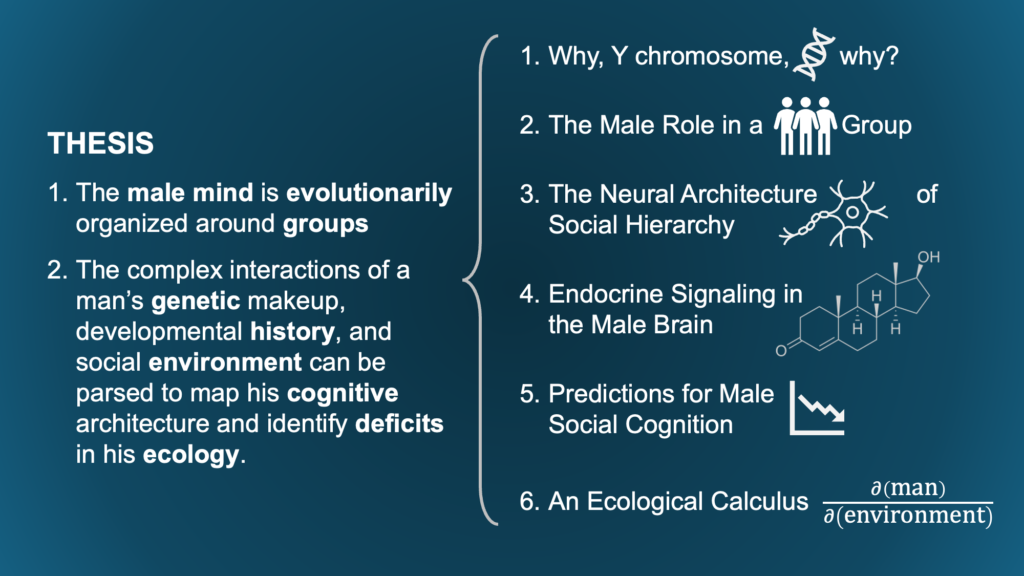
The core thesis is that the male mind is evolutionarily organized around groups, and that the complex interactions of a man’s genetic makeup, developmental history, and social environment can be parsed to map his cognitive architecture and identify deficits in his ecology.
The following essays chart this argument across its biological layers, beginning with a paradox: the Y chromosome initiates male development but does not encode the behavioral variation that distinguishes one man from another. Male behavioral variation — in aggression type, affiliative sensitivity, competitive-cooperative balance, and coalitional orientation — arises from X-linked and autosomal genes whose expression is modulated by endocrine signals, which are calibrated by developmental experience and recalibrated by adult social context. (Essay 1: Why, Y chromosome, why?)
The brain this genetic background produces evolved in groups. Across primates, ungulates, carnivores, cetaceans, and birds, species with larger and more complex social groups have disproportionately larger neocortices relative to body size (Dunbar, 1992, 1998). The human neocortex is the largest relative to body size of any primate, and social network complexity in macaques predicts gray matter volume in the mid-superior temporal sulcus and ventral prefrontal cortex, regions central to social cognition (Sallet et al., 2011; Testard et al., 2022). The male role within social mammalian groups exhibits patterns that predate the primate lineage: males more often lead intergroup conflict while females more often lead collective movements toward resources, a division driven not by body-size dimorphism but by the differential cost-benefit structure of mammalian reproduction (Smith et al., 2022). The behaviors males exhibit within groups decompose into separable dimensions — reactive versus proactive aggression, affiliative approach versus stress-withdrawal, cooperative versus competitive orientation, dominance and subordination signaling, kin and alliance categorization. (Essay 2: The Male Role in a Group)
The neural circuits that implement these behavioral dimensions are computationally dissociable. The hippocampus and ventromedial prefrontal cortex track hierarchical knowledge in a domain-general fashion, coding linear rank structure regardless of whether the items being ranked are people or objects; the amygdala is selectively recruited for social hierarchy learning (Kumaran et al., 2012, 2016). The salience network, centered on the anterior insula and anterior cingulate cortex, routes incoming social stimuli to the appropriate processing stream — default-mode for internal social simulation, executive for real-time social engagement (Menon & Uddin, 2010). The default mode network’s hyperconnectivity is a consistent neural signature of loneliness, with loneliness-linked differences in DMN-associated white matter tract integrity more prominent in men than in women (Spreng et al., 2020). When the salience network receives insufficient co-present social input, the DMN fills the gap with rumination — mentalizing about relationships rather than computing within them. (Essay 3: The Neural Architecture of Social Hierarchy and Male Group Behavior)
The endocrine signals that modulate these circuits — testosterone, oxytocin, and cortisol — operate as an interacting system rather than as independent molecules. Testosterone and oxytocin function as opposing vectors of social cognition (Crespi, 2016), with cortisol gating expression along both axes simultaneously: elevated cortisol suppresses testosterone-mediated competitive behavior and independently suppresses affiliative behavior in men, pushing the stressed male toward disengagement through parallel inhibition (Sherman et al., 2017). This cortisol-affiliation sex-crossover — rising cortisol after defeat predicts increased affiliation in women but decreased affiliation in men — means that ecological deprivation pushes men toward withdrawal while the same deprivation pushes women toward social reconnection. The same hormones that modulate adult behavior also organize the receptor distribution and circuit connectivity they will later act upon, through developmental windows that extend from prenatal testosterone exposure through the fatherhood transition, when testosterone declines and oxytocin rises in proportion to caregiving involvement (Gettler et al., 2011). (Essay 4: Endocrine Signaling Through the Male Social Brain)
The framework’s explanatory power can be compressed into a single worked example. When a plant closes and a man loses his job, mortality rates among high-seniority male workers rise 50–100% in the year after displacement and remain 10–15% elevated for twenty years, an effect that persists after controlling for income loss and pre-displacement health (Sullivan & von Wachter, 2009). A purely economic account would predict that re-employment at equivalent wages should eliminate the mortality effect. A social-capital account would predict that any form of social reconnection should attenuate it. The evidence suggests otherwise. The framework predicts that what was lost was not income or generic social contact but a specific combination of ecological inputs — coalitional boundedness (a workplace with defined membership), positional differentiation (a role with visible contribution), normative accountability (colleagues who notice absence), and shared productive orientation (a group organized around making something) — and that these inputs engaged separable neural subsystems whose decalibration produces effects that income replacement and casual socialization cannot reverse. The sex-specificity of the mortality effect is consistent with the cortisol-affiliation sex-crossover: rising cortisol after status loss predicts increased affiliation in women but decreased affiliation in men (Sherman et al., 2017), pushing displaced men toward withdrawal rather than reconnection. (Essay 5: Predictions for Male Social Cognition)
The same motivational system produces a man who grinds through medical school because that is his group’s status ladder and a man who fights on a corner because that is his. Male biology explains the pull toward visible, coalition-ratified rank; culture explains which activities carry the rank. In a meta-analysis of 148 studies covering 308,849 participants, more complex social integration predicted survival with an odds ratio of 1.91 — a figure that persists after controlling for age, sex, health behaviors, and baseline medical status, and that is of the same order as smoking cessation (Holt-Lunstad et al., 2010). The multidimensional measures that produced this effect size — network diversity, group membership, frequency of contact — map onto the ecological dimensions the final essay will develop into a diagnostic calculus. (Essay 6: An Ecological Calculus)
Conclusion
The digital platforms on which the manosphere is built supply status comparison and mate evaluation without the affiliative bonding the cognitive and endocrine systems co-evolved to produce. The identities promoted by these communities — structured around dominance, sexual acquisition, and hostility toward women — are consistent with the behavioral outputs the framework predicts when male group-seeking and hierarchy-tracking systems are activated by environments that supply competitive feedback without affiliative structure. Our ecologic framework does not treat these identities as moral failures; it treats them as the predictable output of a coupled system operating on impoverished input.
References
Crespi, B. J. (2016). Oxytocin, testosterone, and human social cognition. Biological Reviews, 91(2), 390–408. https://doi.org/10.1111/brv.12175
Dunbar, R. I. M. (1992). Neocortex size as a constraint on group size in primates. Journal of Human Evolution, 22(6), 469–493. https://doi.org/10.1016/0047-2484(92)90081-J
Dunbar, R. I. M. (1998). The social brain hypothesis. Evolutionary Anthropology, 6(5), 178–190. https://doi.org/10.1002/(SICI)1520-6505(1998)6:5%3C178::AID-EVAN5%3E3.0.CO;2-8
Eberstadt, N. (2022). Men without work: Post-pandemic edition. Templeton Press.
GBD 2021 Suicide Collaborators. (2025). Global, regional, and national burden of suicide, 1990–2021: A systematic analysis for the Global Burden of Disease Study 2021. The Lancet Public Health, 10(3), e189–e202. https://doi.org/10.1016/S2468-2667(25)00006-4
Gettler, L. T., McDade, T. W., Feranil, A. B., & Kuzawa, C. W. (2011). Longitudinal evidence that fatherhood decreases testosterone in human males. Proceedings of the National Academy of Sciences, 108(39), 16194–16199. https://doi.org/10.1073/pnas.1105403108
Hoffman, B., Ware, J., & Shapiro, E. (2020). Assessing the threat of incel violence. Studies in Conflict & Terrorism, 43(7), 565–587. https://doi.org/10.1080/1057610X.2020.1751459
Holt-Lunstad, J., Smith, T. B., & Layton, J. B. (2010). Social relationships and mortality risk: A meta-analytic review. PLOS Medicine, 7(7), e1000316. https://doi.org/10.1371/journal.pmed.1000316
Kumaran, D., Melo, H. L., & Duzel, E. (2012). The emergence and representation of knowledge about social and nonsocial hierarchies. Neuron, 76(3), 653–666. https://doi.org/10.1016/j.neuron.2012.09.035
Kumaran, D., Banino, A., Blundell, C., Hassabis, D., & Dayan, P. (2016). Computations underlying social hierarchy learning: Distinct neural mechanisms for updating and representing self-relevant information. Neuron, 92(5), 1135–1147. https://doi.org/10.1016/j.neuron.2016.10.052
Lankford, A., & Silva, J. R. (2024). Sexually frustrated mass shooters: A study of perpetrators, profiles, behaviors, and victims. Homicide Studies, 28(2), 196–219. https://doi.org/10.1177/10887679221106975
Menon, V., & Uddin, L. Q. (2010). Saliency, switching, attention and control: A network model of insula function. Brain Structure and Function, 214(5–6), 655–667. https://doi.org/10.1007/s00429-010-0262-0
OECD. (2025). Education at a Glance 2025: OECD indicators. OECD Publishing. https://doi.org/10.1787/1c0d9c79-en
OECD. (2025). Social connections and loneliness in OECD countries. OECD Publishing. https://doi.org/10.1787/6df2d6a0-en
Pfundmair, M., Wood, N. R., Hales, A., & Wesselmann, E. D. (2022). How social exclusion makes radicalism flourish: A review of empirical evidence. Journal of Social Issues, 80(1), 341–359. https://doi.org/10.1111/josi.12520
Putnam, R. D. (2000). Bowling alone: The collapse and revival of American community. Simon & Schuster.
Reeves, R. V. (2022). Of boys and men: Why the modern male is struggling, why it matters, and what to do about it. Brookings Institution Press.
Reeves, R. V., Nzau, S., & Smith, E. (2025). A generation of lost men? The reality of NEET data. American Institute for Boys and Men. https://aibm.org/research/a-generation-of-lost-men-the-reality-of-neet-data/
Sallet, J., Mars, R. B., Noonan, M. P., Andersson, J. L., O’Reilly, J. X., Jbabdi, S., Croxson, P. L., Jenkinson, M., Miller, K. L., & Rushworth, M. F. S. (2011). Social network size affects neural circuits in macaques. Science, 334(6056), 697–700. https://doi.org/10.1126/science.1210027
Sherman, G. D., Rice, L. K., Jin, E. S., Jones, A. C., & Josephs, R. A. (2017). Sex differences in cortisol’s regulation of affiliative behavior. Hormones and Behavior, 92, 20–28. https://doi.org/10.1016/j.yhbeh.2016.12.005
Smith, J. E., Fichtel, C., Holmes, R. K., Kappeler, P. M., van Vugt, M., & Jaeggi, A. V. (2022). Sex bias in intergroup conflict and collective movements among social mammals: Male warriors and female guides. Philosophical Transactions of the Royal Society B: Biological Sciences, 377(1851), 20210142. https://doi.org/10.1098/rstb.2021.0142
Spreng, R. N., Dimas, E., Mwilambwe-Tshilobo, L., Dagher, A., Koellinger, P., Nave, G., Ong, A., Kernbach, J. M., Wiecki, T. V., Ge, T., Li, Y., Holmes, A. J., Yeo, B. T. T., Turner, G. R., Dunbar, R. I. M., & Bzdok, D. (2020). The default network of the human brain is associated with perceived social isolation. Nature Communications, 11(1), 6393. https://doi.org/10.1038/s41467-020-20039-w
Sullivan, D., & von Wachter, T. (2009). Job displacement and mortality: An analysis using administrative data. Quarterly Journal of Economics, 124(3), 1265–1306. https://doi.org/10.1162/qjec.2009.124.3.1265
Testard, C., Brent, L. J. N., Andersson, J., Chiou, K. L., Negron-Del Valle, J. E., DeCasien, A. R., Acevedo-Ithier, A., Stock, M. K., Antón, S. C., Gonzalez, O., Walker, C. S., Foxley, S., Compo, N. R., Bauman, S., Ruiz-Lambides, A. V., Martinez, M. I., Skene, J. H. P., Horvath, J. E., Cayo Biobank Research Unit, … Sallet, J. (2022). Social connections predict brain structure in a multidimensional free-ranging primate society. Science Advances, 8(15), eabl5794. https://doi.org/10.1126/sciadv.abl5794