Predictions for Male Social Cognition
The preceding essays argue that men’s cognition, shaped through evolutionary selection for group living, is primarily oriented towards hierarchy tracking and coalition membership, and that the behavioral outcomes are endocrine mediated. If this argument is correct, then it generates predictions that can be tested against real-world evidence from outside the laboratory, namely large-scale changes in group structure and membership that economies and policies induce on populations.
This essay outlines select naturalistic situations that provide evidence of the framework’s validity. Each situation manipulates a different input in the framework’s argument: employment and contribution, marriage-market access, and group membership. The behavioral outcomes are evaluated through mortality records, crime statistics, and/or hospitalization data.
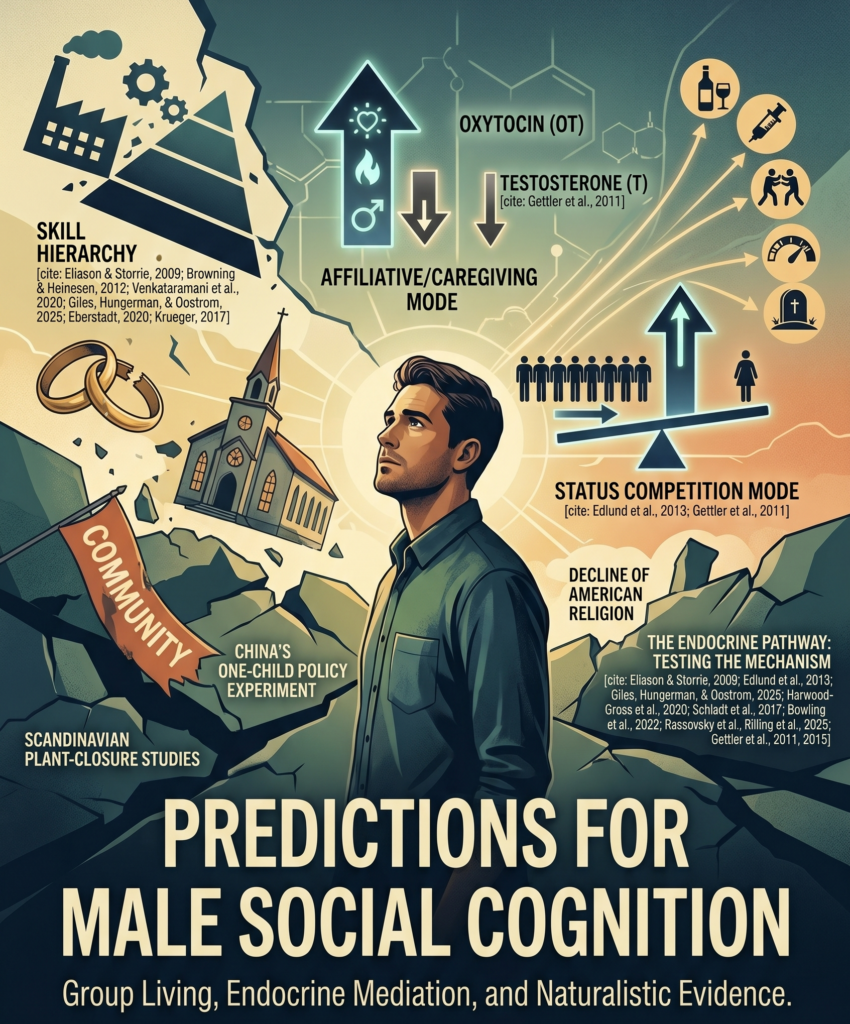
The Scandinavian Plant-Closure Studies
Two Scandinavian studies evaluated how men’s wellbeing is coupled to social structure by examining the health and mortality of employees through business closures. Eliason and Storrie (2009) identified all workers displaced by establishment closures in Sweden in 1987 and 1988 and followed them through national mortality and hospitalization registers. The overall mortality hazard for displaced men was approximately 44 percent higher than for matched non-displaced controls during the first four years following job loss (i.e., a hazard ratio of roughly 1.44); there was no corresponding effect on female overall mortality, either in the short run or the long run. The cause-specific pattern was more nuanced than the headline mortality figure suggests. Job loss did not increase the risk of myocardial infarction or stroke for either sex — a finding the authors note is consistent with several other recent studies. The excess male mortality was driven primarily by suicides and alcohol-related causes, which showed approximately a twofold unadjusted increase following displacement, though adjustment for baseline risk factors reduced these estimates to roughly 20 percent increases in hospitalization risk. The sex pattern in the hospitalization data complicates a simple male-vulnerability reading: after adjustment, the increase in alcohol-related hospitalization was actually larger for women than for men, while the increase in self-harm hospitalization was specific to men. Age stratification revealed further structure: men aged 35-49 experienced the largest stroke risk increase (about 40 percent), the youngest men showed the most pronounced increases in alcohol-related and self-harm hospitalization, and marriage appeared to moderate the effect differently by sex — married men showed the largest alcohol-related effects, while marriage was protective for women’s alcohol and self-harm outcomes (Eliason & Storrie, 2009).
Browning and Heinesen (2012) extended this design using a panel of all persons in Denmark from 1980 to 2006, linked to plant-level records. They confirmed that displacement due to plant closure increases the risk of overall mortality, death from circulatory disease, suicide and suicide attempts, and hospitalization due to traffic accidents, alcohol-related disease, and mental illness. The mortality hazard ratio was 2.39 in the year of closure itself, declining to 1.35 over the first four years, 1.17 over the first ten years, and 1.11 even twenty years after displacement (Browning & Heinesen, 2012). The persistence of the effect — still statistically significant two decades out — argues against a transient stress response and toward a structural reorganization of health trajectories following the loss of the contribution-and-coalition input.
The Danish data’s temporal resolution allows a further inference. Alcohol-related hospitalization and death increased in both the short and long term, while suicide risk was concentrated in the first three years after displacement and then attenuated. Traffic-accident mortality, by contrast, was smaller initially and grew over time. These distinct temporal profiles suggest that several downstream pathways are activated by the same upstream shock, each with its own dynamics — a pattern consistent with the framework’s claim that multiple behavioral channels are engaged (affiliative withdrawal, substance use as interoceptive modulation, impulsive risk-taking) when expected social-structural inputs are removed.
The Venkataramani et al. (2020) analysis of US automobile-plant closures and county-level opioid mortality provides a geographic complement. Counties that experienced an auto-plant closure saw significantly greater increases in opioid mortality between 1999 and 2016 than comparable counties that did not. The automobile plant is a specific instance of the broader category — a male-coded coalitional workplace with a visible skill hierarchy and durable membership — and its removal produces a geographically localized mortality signature in the population the framework identifies as most dependent on that input.
What the plant-closure evidence does not resolve is the relative contribution of income loss, identity loss, and coalition loss to the downstream effects. Displaced workers lose money, daily structure, and group membership simultaneously, and the administrative data cannot separate these channels. The sex-asymmetry — men die at higher rates while women do not — is consistent with the framework’s claim that the male behavioral system is more tightly coupled to the contribution-and-rank pathway, but it is also consistent with a simpler account in which men’s identities are more culturally invested in the provider role. The framework claims to explain why the cultural investment exists; the plant-closure data, on its own, does not adjudicate between the cultural and architectural accounts.
The Marriage Effect and Its Structural Discontinuity
The framework predicts that durable coalition membership with a recognizable dependency structure stabilizes male behavioral outputs. Marriage is the smallest and most intimate instance of such a structure — a dyadic coalition with clear mutual dependency and continuous social feedback. If the architectural account is correct, marital status should predict male behavioral and economic outcomes with a magnitude disproportionate to what selection on observed characteristics would explain.
Nicholas Eberstadt’s analysis of prime-age male labor-force participation in the US demonstrates this pattern at a scale that is difficult to attribute to selection alone. Married prime-age male high-school dropouts generate labor-force participation rates comparable to those of their never-married, college-graduate peers — a swing of roughly twenty to forty percentage points from a variable that, on pure human-capital grounds, should be modestly relevant (Eberstadt, 2020). The marriage effect is larger than the education effect, larger than the race effect, and roughly comparable to the nativity effect (foreign-born men participate at higher rates than native-born men in the same educational stratum). The only other variable that produces a discontinuity of similar magnitude is incarceration history.
The endocrine literature provides a prospective complement. Gettler et al.’s (2011) longitudinal study of Filipino men in the Cebu cohort measured testosterone at baseline — before any partnership or fatherhood transition — and then followed men through those transitions. Men with higher baseline testosterone were more likely to become partnered fathers, consistent with the framework’s prediction that the competitive vector facilitates mate acquisition. Upon becoming fathers, the same men showed steeper testosterone declines, with the largest declines among those reporting the highest caregiving involvement. The within-person, prospective design rules out the selection explanation that low-testosterone men become more involved fathers; instead, the transition into the dependency structure itself recalibrates the endocrine system in the direction the framework predicts — from competitive-mode toward caregiving-mode (Gettler et al., 2011).
Alan Krueger’s American Time Use Survey analysis adds the subjective-wellbeing dimension. Prime-age men outside the labor force report notably low emotional wellbeing throughout their days and derive little meaning from daily activities. Women outside the labor force who cite home responsibilities as their primary reason report wellbeing levels comparable to employed women; women outside the labor force for other reasons report wellbeing as low as non-working men’s (Krueger, 2017). The sex-asymmetry in wellbeing tracks the framework’s prediction: labor-force absence in the service of an existing dependency structure (caregiving) does not produce the meaning-collapse; labor-force absence without a role substitute does. For men, labor-force absence produces the collapse almost uniformly, suggesting that the male motivational system has fewer available alternative pathways through which to generate the experience of contribution.
China’s One-Child Policy and the Sex-Ratio Experiment
The framework predicts that when the ratio of men to women in the marriageable population shifts, the intensity of male status competition should increase, and the behavioral consequences of that increase should concentrate among young, low-status men. China’s one-child policy, introduced in 1979 and implemented with varying intensity across provinces, produced a large, exogenous, and geographically variable increase in the sex ratio at birth — from approximately 1.06 in 1980 to as high as 1.20 in some provinces by the early 2000s (Edlund et al., 2013). Because the provincial rollout was driven by the characteristics of local party secretaries who were systematically rotated, and because these leader characteristics were serially uncorrelated after ten years, the province-level implementation can be used as an instrument for the sex ratio of young adults in subsequent decades.
Using annual province-level data from 1988 to 2004, a 0.01 increase in the sex ratio of 16- to 25-year-olds raised violent and property crime rates by approximately three percent, implying that male sex ratios can account for roughly one-seventh of the overall rise in crime during this period (Edlund et al., 2013). The effect is concentrated where the framework predicts: among young men whose marriage prospects are most directly compressed by the ratio. The same analysis tests the prediction’s boundary by examining corruption rates — a form of crime committed by older, higher-status individuals whose marriage prospects are not directly affected by the young-adult sex ratio. No effect of the 16-25 sex ratio on corruption rates was found, a falsification test that the framework passes.
The mechanism channel receives further support from survey and experimental data. Chinese men in high-sex-ratio environments show elevated risk-taking and reduced patience in incentivized experimental tasks (Cameron et al., 2013), consistent with the framework’s prediction that an intensified status-competition environment recalibrates male behavioral parameters toward short-term, high-variance strategies. Marriage-market data confirms the downstream pathway: high sex ratios lower men’s probability of marriage, raise the spousal age gap, and reduce men’s bargaining power within marriages that do form. These patterns are consistent with a contest formalization in which higher competition raises the marginal return to investment in status signals, whether prosocial (education, savings) or antisocial (theft, violence) (Edlund et al., 2013).
The rural-China qualitative and survey evidence sharpens the picture further. In Anhui province, where the sex ratio of never-married men aged 30-39 reached 411 men per 100 women in rural areas by the 2010 census, marriage-squeezed men show elevated rates of alcohol use disorder, gambling, verbal conflict, and suicidal ideation relative to married men and to men who do not perceive themselves as squeezed (Yang et al., 2019). The cross-cultural evidence on which this finding rests — that violent crime is disproportionately committed by young, unmarried, low-status males across diverse societies (Daly & Wilson, 1988; Drèze & Khera, 2000) — is the population the framework identifies as most dependent on status-competition pathways and most vulnerable to their foreclosure.
Two limitations constrain the inferential reach of the Chinese evidence. First, the one-child policy changed many things simultaneously — family structure, parental investment patterns, labor-force composition, rural-urban migration dynamics — and isolating the sex-ratio channel from these correlated changes requires assumptions that are difficult to verify. Second, the framework’s prediction is not unique: a purely rational-choice model in which men compete harder when mates are scarcer generates the same directional prediction without invoking any architectural claim about the male brain. The architectural account offers a deeper explanation — it says why the competitive preferences exist and why they are sex-differentiated — but the Chinese natural experiment, on its own, does not distinguish explanatory depth from surface prediction.
The Decline of Religious Attendance and Deaths of Despair
The framework predicts that durable group membership with shared identity, regular co-presence, and recognizable contribution roles is protective for men, and that the loss of such membership should produce downstream mortality consequences through the behavioral channels the architecture controls — substance use, suicidal behavior, and the withdrawal-from-affiliation pattern that the cortisol-gating model predicts. Religious congregations are among the oldest and most durable instances of this kind of group. Their decline in the United States provides a natural experiment whose identification strategy is unusually clean.
Giles, Hungerman, and Oostrom (2025) show that deaths of despair — suicide, drug poisoning, and alcoholic liver disease — began to increase among middle-aged white Americans in the early 1990s, and that this increase was preceded by a decline in religious participation concentrated among the same demographic group: white adults without a college degree. States with larger declines in religious attendance from 1985 to 2000 experienced larger subsequent increases in deaths of despair. The temporal ordering — religious decline preceding the mortality increase, which in turn preceded the introduction of OxyContin in 1996 — argues against the opioid crisis as the sole or initial cause.
The instrumental-variable strategy exploits the repeal of “blue laws” that had restricted Sunday commerce. When states repealed these laws — with a large wave in 1985 (Minnesota, South Carolina, and Texas) — the opportunity cost of church attendance rose, and weekly attendance fell by five to ten percentage points. In those same states, deaths of despair subsequently increased by approximately two per 100,000 population, equivalent to a four percent increase over the average mortality rate for this age group. The blue-law instrument is plausibly exogenous to underlying despair or health trends, since the laws were repealed for commercial rather than health-related reasons (Giles, Hungerman, & Oostrom, 2025).
The authors tested whether the decline in religious attendance was accompanied by a decline in other forms of social activity. It was not — people who stopped attending church did not, on average, reduce their participation in other social groups during the same period. Religious belief itself also did not decline; what changed was organizational participation and self-identified affiliation. The active ingredient appears to be membership in a specific kind of durable, identity-conferring group rather than social contact in general — a finding that aligns with the framework’s prediction that the coalitional inputs the architecture tracks have particular structural properties (shared identity, regular co-presence, recognizable norms) rather than constituting generic sociality. Complementary evidence from the Harvard T.H. Chan School’s prospective cohort studies — the Nurses’ Health Study II (66,492 women) and the Health Professionals Follow-Up Study (43,141 men) — confirms the protective association at the individual level. Weekly religious attendance was associated with a 33 percent lower risk of death from despair among men and a 68 percent lower risk among women, after adjusting for numerous covariates (Chen et al., 2020).
The sex pattern in the prospective data introduces a complication for the framework. The relative risk reduction is larger for women than for men, which is the opposite of what the framework would predict if male wellbeing were more tightly coupled to coalitional membership. The resolution may lie in the absolute numbers: among the health professionals studied, men experienced 306 deaths from despair (out of 43,141) compared to 75 among women (out of 66,492). The male baseline rate is roughly six times higher. Religious attendance compresses this gap substantially, but it compresses it further for women in relative terms because women’s baseline risk is so much lower. The framework can accommodate this pattern — the male behavioral system produces a higher floor of despair-related mortality that even strong protective factors only partially offset — but the accommodation is post-hoc rather than predicted.
The Endocrine Pathway: Testing the Mediating Mechanism
The natural experiments above test whether the removal or compression of social-structural inputs produces the behavioral and mortality outcomes the framework predicts. If the endocrine system is the mediating pathway, then oxytocin should rise with affiliative group engagement, testosterone should shift in response to status transitions, and the two should interact in the opposing-vector pattern that the Crespi model describes.
The transition to fatherhood is the most extensively characterized naturalistic endocrine test. Gettler et al.’s (2011) Cebu longitudinal study, discussed in the preceding essays, established that men who transitioned from single non-fathers to partnered residential fathers showed within-person testosterone declines, with the steepest declines among men reporting the highest caregiving involvement. Subsequent longitudinal work in the same cohort confirmed that men who increased their weekly involvement in caregiving experienced additional testosterone declines relative to fathers whose involvement remained stable (Gettler et al., 2015). On the oxytocin side, a recent longitudinal study of 51 first-time fathers with four measurement points spanning mid-gestation through four months postpartum found that oxytocin levels increased across the gestational period, and that lower prenatal testosterone and vasopressin predicted greater postnatal paternal investment in the mother and child (Rilling et al., 2025). The within-person prospective design of these studies rules out the selection explanation — the same men who had higher testosterone before the transition show steeper declines after it, which means the transition itself is recalibrating the endocrine system rather than revealing a pre-existing difference. The direction of the recalibration — testosterone declining, oxytocin rising, caregiving quality tracking the shift — is what the framework’s opposing-vectors model predicts when a man enters a durable affiliative coalition with a dependent.
The martial arts literature provides a more acute test of whether structured physical contact within a dyadic social interaction activates the oxytocinergic system. Rassovsky et al. (2019) measured salivary oxytocin at baseline, immediately after high-intensity jiu-jitsu training, and after a cool-down period in 68 practitioners. Oxytocin increased significantly during training and returned to baseline after cool-down. The design included a comparison between two styles of training: ground grappling, which involves sustained close physical contact with a partner, and punch-kick sparring, which involves less tactile interaction at greater interpersonal distance. Oxytocin increased significantly more during grappling than during sparring, and the difference could not be explained by variation in training intensity — heart rate and perceived exertion were comparable across conditions. Experience level (beginner vs. advanced) did not moderate the effect. The authors attributed the grappling-specific increase to the greater tactile stimulation of close-contact dyadic interaction, a conclusion consistent with the broader literature linking affiliative touch to oxytocin release across mammalian species (Rassovsky et al., 2019).
The follow-up study by the same group extended this design to at-risk adolescent boys — the population whose architectural vulnerability the framework most directly predicts. Harwood-Gross et al. (2020) measured oxytocin and cortisol reactivity during martial arts training in youths attending specialized educational facilities for behaviorally at-risk adolescents, compared to low-risk controls in conventional schools. Low-risk youths showed significantly higher baseline oxytocin and the standard pattern of oxytocin increase during peak training. High-risk youths showed blunted oxytocin reactivity — a lower baseline and a flatter response curve. After six months of twice-weekly martial arts training, initial hormonal reactivity predicted subsequent improvement on cognitive measures including inhibition and cognitive flexibility, as well as on psychological measures including aggression and self-esteem (Harwood-Gross et al., 2020). The blunted oxytocin reactivity in high-risk youths is consistent with the framework’s developmental prediction that early adversity calibrates the oxytocin system to a lower baseline, and the finding that a structured, physically co-present, dyadic intervention can partially engage that system — and that the degree of engagement predicts downstream cognitive and behavioral improvement — provides preliminary evidence that the endocrine pathway is doing mechanistic work rather than merely correlating with outcomes.
Group singing provides a third test, with a different structural profile: synchronized vocalization in a co-present group, without physical contact. Schladt et al. (2017) used a within-subjects repeated-measures design in which members of a university choir (n = 38 with usable oxytocin data) completed both choir and solo singing conditions. Salivary oxytocin decreased after solo singing but was maintained after choir singing, producing a significant difference between conditions — choir singing preserved oxytocin levels that solo singing did not. Cortisol declined after both conditions, with a significantly greater decline after choir singing. Mood improvements, including reduced anxiety and increased positive affect, were larger in the choir condition (Schladt et al., 2017). A subsequent study by Bowling et al. (2022) extended this design by crossing vocal production mode (singing vs. speaking) with social context (together vs. alone) in a choir of 71 young adults, and added an exploratory analysis of testosterone in males. Salivary oxytocin was significantly higher after singing together than after speaking together, controlling for baseline differences. Cortisol declined across all conditions. Testosterone showed no significant effects, though the male subsample was underpowered for this analysis. Singing together produced larger positive shifts in affect and greater feelings of social connection than speaking together (Bowling et al., 2022).
Conclusions
The naturalistic evidence reviewed here varies in geography, policy context, and the specific social-structural variables affected. Each case removes or compresses one category of input — employment within a stable coalition, access to a marriage market, regular group membership — and each produces downstream consequences through the behavioral channels the ecologic framework identifies: men displaced from coalitional structures show elevated substance use and suicidal behavior; men in surplus in a distorted marriage market show escalating status-competitive violence; men whose civic and religious participation declines show affiliative withdrawal and rising mortality. These population-level outcomes provide confirmatory evidence of the framework’s explanatory potential.
These observational experiments share a limitation, however, that bounds what they can tell us about the conditions most individuals actually face. Plant closures, sex-ratio distortions, and blue-law repeals are discrete shocks to identifiable inputs, but most contemporary social change is more subtle and varied. The inputs the framework describes — stable employment with a skill hierarchy, marriage and its dependency structure, religious and civic group membership with regular co-presence — are not being removed one at a time in cleanly instrumented natural experiments. They are eroding concurrently, at different rates, with partial substitutes emerging for some inputs and none for others. Thus, characterizing the ecology at an individual level is the work of the final essay.
References
Bowling, D. L., Gahr, J., Graf Ancochea, P., Hoeschele, M., Canoine, V., Fusani, L., & Fitch, W. T. (2022). Endogenous oxytocin, cortisol, and testosterone in response to group singing. Hormones and Behavior, 139, 105105. https://doi.org/10.1016/j.yhbeh.2021.105105
Browning, M., & Heinesen, E. (2012). Effect of job loss due to plant closure on mortality and hospitalization. Journal of Health Economics, 31(4), 599–616. https://doi.org/10.1016/j.jhealeco.2012.03.001
Cameron, L., Erkal, N., Gangadharan, L., & Meng, X. (2013). Little emperors: Behavioral impacts of China’s one-child policy. Science, 339(6122), 953–957. https://doi.org/10.1126/science.1230221
Chen, Y., Koh, H. K., Kawachi, I., Botticelli, M., & VanderWeele, T. J. (2020). Religious service attendance and deaths related to drugs, alcohol, and suicide among US health care professionals. JAMA Psychiatry, 77(7), 737–744. https://doi.org/10.1001/jamapsychiatry.2020.0175
Daly, M., & Wilson, M. (1988). Homicide. Aldine de Gruyter.
Drèze, J., & Khera, R. (2000). Crime, gender, and society in India: Insights from homicide data. Population and Development Review, 26(2), 335–352. https://doi.org/10.1111/j.1728-4457.2000.00335.x
Eberstadt, N. (2020, Winter). Education and men without work. National Affairs, 42. https://www.nationalaffairs.com/publications/detail/education-and-men-without-work
Edlund, L., Li, H., Yi, J., & Zhang, J. (2013). Sex ratios and crime: Evidence from China. Review of Economics and Statistics, 95(5), 1520–1534. https://doi.org/10.1162/REST_a_00356
Eliason, M., & Storrie, D. (2009). Does job loss shorten life? Journal of Human Resources, 44(2), 277–302. https://doi.org/10.3368/jhr.44.2.277
Gettler, L. T., McDade, T. W., Feranil, A. B., & Kuzawa, C. W. (2011). Longitudinal evidence that fatherhood decreases testosterone in human males. Proceedings of the National Academy of Sciences, 108(39), 16194–16199. https://doi.org/10.1073/pnas.1105403108
Gettler, L. T., McDade, T. W., Agustin, S. S., Feranil, A. B., & Kuzawa, C. W. (2015). Longitudinal perspectives on fathers’ residence status, time allocation, and testosterone in the Philippines. Adaptive Human Behavior and Physiology, 1(2), 124–149. https://doi.org/10.1007/s40750-014-0018-9
Giles, T., Hungerman, D., & Oostrom, T. (2025). Deaths of despair and the decline of American religion. Journal of the European Economic Association, jvaf048. https://doi.org/10.1093/jeea/jvaf048
Harwood-Gross, A., Feldman, R., Zagoory-Sharon, O., & Rassovsky, Y. (2020). Hormonal reactivity during martial arts practice among high-risk youths. Psychoneuroendocrinology, 121, 104806. https://doi.org/10.1016/j.psyneuen.2020.104806
Krueger, A. B. (2017). Where have all the workers gone? An inquiry into the decline of the U.S. labor force participation rate. Brookings Papers on Economic Activity, 2017(2), 1–87. https://doi.org/10.1353/eca.2017.0012
Rassovsky, Y., Harwood, A., Zagoory-Sharon, O., & Feldman, R. (2019). Martial arts increase oxytocin production. Scientific Reports, 9(1), 12980. https://doi.org/10.1038/s41598-019-49620-0
Rilling, J. K., Lee, M., Zhou, C., & Jung, E. (2025). Hormonal changes in first-time human fathers in relation to paternal investment. Hormones and Behavior, 169, 105740. https://doi.org/10.1016/j.yhbeh.2025.105740
Schladt, T. M., Nordmann, G. C., Emilius, R., Kudielka, B. M., de Jong, T. R., & Neumann, I. D. (2017). Choir versus solo singing: Effects on mood, and salivary oxytocin and cortisol concentrations. Frontiers in Human Neuroscience, 11, 430. https://doi.org/10.3389/fnhum.2017.00430
Venkataramani, A. S., Bair, E. F., O’Brien, R. L., & Tsai, A. C. (2020). Association between automotive assembly plant closures and opioid overdose mortality in the United States: A difference-in-differences analysis. JAMA Internal Medicine, 180(2), 254–262. https://doi.org/10.1001/jamainternmed.2019.5686
Yang, X., Wang, S., & Eklund, L. (2019). Reacting to social discrimination? Men’s individual and social risk behaviors in the context of a male marriage squeeze in rural China. Social Science & Medicine, 243, 112729. https://doi.org/10.1016/j.socscimed.2019.112729