The Picket Fence Concept Home
Pittsburgh, Pennsylvania, United States
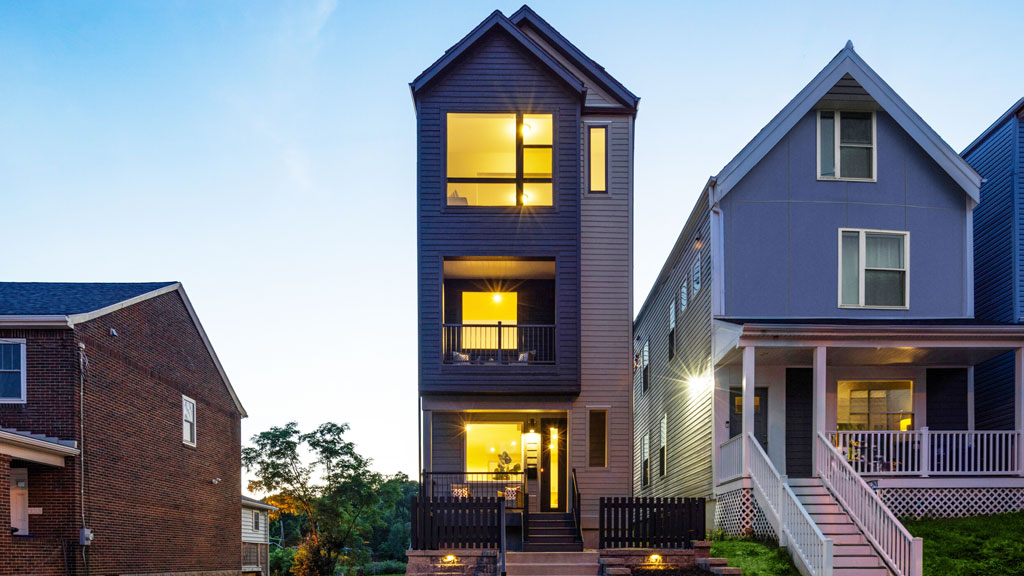
The Picket Fence is a “concept home” constructed on a narrow urban infill lot in Pittsburgh, Pennsylvania, using consumer insights from the America at Home Study. The project was launched to inspire new ways that builders and architects can work together to create healthy and sustainable homes using design innovations and system-built construction solutions, while maintaining a focus on economic attainability.
The three-story structure is a two-unit detached townhouse, with a 2,007-square-foot two-story unit sitting above a 660-square-foot studio accessory dwelling unit (ADU). The ground-floor studio residence has a street-facing entry porch; the townhome above has three bedrooms, 2.5 bathrooms, a flex space, a covered balcony, and a rear private entry with parking.
The Picket Fence is located in the walkable Garfield neighborhood in Pittsburgh’s East End and was designed to appeal to millennials seeking an active, sustainable urban lifestyle. Completed in 2024, both residences are now occupied. As a concept home, it aims to provide a framework for builders to deliver housing solutions that exceed expectations while remaining financially attainable and easier to construct in urban settings.
Distinctive Approaches to Wellness
Identifying top wellness needs through consumer research
The Picket Fence was inspired by the America at Home Study, launched during the COVID-19 pandemic to survey Americans on their home-related behaviors and priorities. Across four survey periods, the study collected nearly 16,000 responses from U.S. households earning over $50,000.
The research identified key wellness and sustainability features, including energy and water conservation, elimination of harmful chemicals, improved air and water filtration, and efficient living spaces. It also highlighted wellness as a major purchase motivator for homebuyers and renters.
The study guided the design of The Picket Fence, developed through collaboration between tst ink, Strategic Solutions Alliance, DAHLIN Architecture, the Housing Innovation Alliance, and Structural Modular Innovations. It is the second concept home from the initiative.
Addressing housing scarcity and affordability through urban infill
The study revealed widespread dissatisfaction with financial wellbeing tied to housing affordability. With median U.S. home prices reaching $442,000 in 2024 and a shortage of 2.1 million units, innovative solutions are critical.
The Picket Fence addresses this by fitting two residences into one structure while preserving private outdoor space. This “townhome+1” model supports affordability through shared land use and potential rental income from the ADU.
The design also integrates with the historic Garfield neighborhood, maintaining architectural character while meeting modern lifestyle needs. Features like street-facing porches and alley-access parking support both community connection and functionality.
Delivering wellness through intentional and flexible design
The home targets the “Trail Blazers” demographic—millennials prioritizing wellbeing, flexibility, and social connectivity. Design features include natural light, outdoor connections, built-in storage, and adaptable spaces.
The layout follows a “spaces, not rooms” philosophy, maximizing functionality. Flex spaces throughout the home support work, exercise, relaxation, and entertainment, reflecting evolving lifestyle needs.
Design elements also enhance safety and community interaction, with separate entrances, elevated porches, and neighborhood-facing features.
Piloting innovative construction to expand healthy housing
The project uses volumetric modular construction (VMC) to deliver a cost-effective, sustainable housing solution. Factory-built modules were assembled on-site in one day, reducing disruption and improving efficiency.
This approach enhances quality control, reduces waste, improves worker safety, and accelerates construction timelines. The home includes energy-efficient systems such as heat pumps, advanced insulation, air purification, and triple-pane windows.
By combining design innovation with scalable construction methods, The Picket Fence offers a replicable model for addressing housing shortages while improving wellness outcomes.
To learn more, see GWI’s report: Build Well to Live Well: Case Studies, Volume 1.