Wellness Real Estate Case Study
American Cancer Society Richard M. Schulze Family Foundation Hope Lodge
Houston, Texas, United States
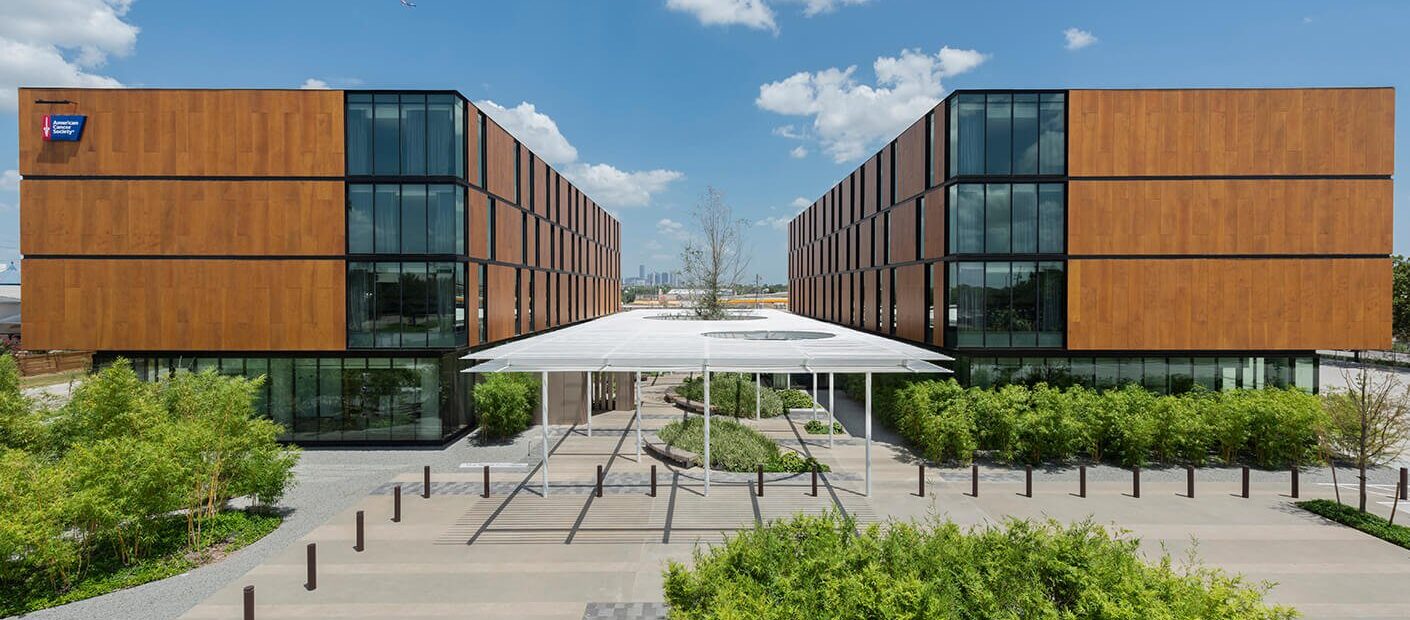
The American Cancer Society Richard M. Schulze Family Foundation Hope Lodge© in Houston, Texas (henceforth referred to as Hope Lodge Houston) is one of the newest among more than 30 American Cancer Society (ACS) Hope Lodges located across the United States. Cancer treatment is stressful, time-consuming and expensive; for patients who need to travel far away from home to receive treatment, there is the added financial burden of paying for lodging, food and transportation. The ACS Hope Lodge program, founded in 1970, aims to provide a free home away from home for cancer patients and their caregivers when they travel for treatment. Hope Lodge Houston, which opened in 2021, is a 64,000 square feet facility located near the Texas Medical Center campus and its various hospitals and cancer treatment centers. The lodge offers 64 one-bedroom suites free of charge, on a first-come, first-served basis, to qualified patients undergoing active cancer treatment, through referral by their treatment centers. There is no limit to how long patients can stay—some have stayed for up to a year or more—as long as they continue to be in active treatment. While there is no housekeeping service, the lodge provides free linens, laundry facilities and cleaning supplies to guests. Hope Lodge Houston is essentially a hospitality complex hosting guests with medical conditions and specialized needs, staffed by professionals as well as a group of dedicated volunteers. According to Perkins&Will, the overall design of Hope Lodge Houston “seeks to develop a building as a sanctuary, providing refuge and a sense of rejuvenation and hope, helping to generate the energy and camaraderie necessary to promote the healing process.”1
Distinctive approaches to wellness
Do no harm to cancer patients
One of the guiding principles for wellness real estate is to “do no harm,” or making sure that a building’s materials, design and operations do not bring harm to its occupants. At Hope Lodge Houston, the main occupants are cancer patients undergoing active treatment. With this in mind, the designers decided to take the “do no harm” principle to the highest level, knowing that guests are recovering from recent surgeries, or may have mobility issues, compromised immune systems, or heightened sensitivity to allergens, smells and noise. Careful consideration was given to every aspect of the building’s materials, design, environment and operations, to ensure that they are as healthy as possible. The design team hired an industrial hygienist to analyze the water and air around the site and assess the need for filtration. Finding an uncomfortable amount of petroleum byproducts in Houston’s water supply, the team decided to install an advanced water filtration system to deliver the highest quality water within the building. Due to air quality concerns, the design team decided against using natural ventilation (i.e., windows do not open). The mechanical system was designed to provide space downstream of primary MERV 13 filters for future carbon filters. The team also examined more than 80 different building materials and substances of concern within them, to ensure they are safe for immunocompromised occupants. “We’re housing people with cancer, so we don’t need to expose them to more carcinogens,” said Tori Wickard, an architect on the design team.
A lot of thought went into the spatial design, as well as the selection of interior finishes, furnishings and materials that do not trap dust and are easy to clean. The design team adopted a hospital-like mindset about preventing infections, while still trying to create spaces that are not clinical or antiseptic-looking. Suites are designed to be acoustically private to minimize disturbances to guests. Due to the heightened olfactory sensitivity of some cancer patients, and their reactions to cooking smells, commercial-grade exhaust fans are installed over all cooking stoves and ventilate directly to the outside. Deliberate physical barriers (glass walls and doors) separate the community kitchen and dining areas from the rest of the lodge to reduce the spread of food and cooking smells.
Harnessing biophilia for physical, mental and social wellbeing
Going through cancer treatment is stressful for both patients and their caregivers, so guests at Hope Lodge Houston appreciate being in an environment that strengthens their feelings of wellness and resilience. The design team incorporated biophilia as a central principle throughout the facility to create a human-centered and healing environment. Hope Lodge Houston comprises two four-story buildings connected by a low-rise structure that houses the reception area, offices, meeting/gathering spaces and communal kitchen and dining area. The buildings frame an interior courtyard, or cloister, with a Healing Garden that brings rejuvenating natural light into all interior spaces. All guest rooms and communal spaces (waiting, lounging, dining and socializing areas) have a view of the garden, giving occupants the benefit of a tranquil view of nature and beauty. On a practical level, the design team said that this arrangement also shields occupants from the noise and vehicular exhaust from the exterior surrounding highways and high-traffic roads. Views of nature are crucial to delivering biophilic benefits at Hope Lodge Houston because indoor plants are not feasible in this kind of facility; in fact, potted plants or floral arrangements are strictly not allowed in the building because pollen and other allergens can affect cancer patients. Other biophilic elements include interior finishings dominated by wood and natural materials in neutral colors. The large, floor-to-ceiling windows let in ample natural light, and the feeling of being connected to nature and daylight can bring patients a sense of energy, rejuvenation and optimism.
Cooking and sharing food for healing and community
Healthy eating is a key pillar of wellness. For cancer patients, being able to cook healthy meals is not only important for nourishment but also a financial relief from ordering restaurant food or buying pre-prepared meals. Besides the Healing Garden, the other centerpiece of Hope Lodge Houston is the community kitchen and dining room. The community kitchen is very spacious, with plenty of stoves, cookware, dishware and dishwashing machines. Each guest is provided a designated kitchen storage area, as well as refrigerator/freezer spaces. Since all guests have traveled away from home, far from their usual support systems, it is important that they find community and social connections in an otherwise isolating circumstance. To cook and eat at Hope Lodge Houston is to see prosocial design at work. The community kitchen and dining room is essentially the facility’s social hub—where caregivers from all over the country and the world cook alongside one another, sharing recipes, equipment and food; where patients swap cancer war stories and trade advice on hospitals, doctors, treatment options and medical insurance; and where guests offer each other solidarity, comfort, support and encouragement during their cancer journeys. There is also celebration whenever a guest finishes treatment and checks out to go home. The community kitchen space is designed to provide a homelike environment and enable a nurturing community where guests become one another’s support systems.
To learn more about this case study and others, see GWI’s Build Well to Live Well: Case Studies, Volume 1.